Friday, June 19, 2015

Possibilities - Wholeness is Emergent

I am not the swiftest thinker but seems like an unusual series of things have come into my sight in the past week that might spell the emergence of wholeness of thinking to a degree rarely visible in our culture. Let me share five of those!

I just finished reading this morning this piece by Rabbi Michael Lerner, founder and publisher of Tikkun, a thoughtful journal of our times.
Tikkun In this deeply resonant piece entitled, "Yearning for a World of Love and Justice" Lerner, co-founder of the Network for Spiritual Progressives, lays out a ten point new Spiritual Covenant.

1. We will create a society that promotes rather than undermines loving and caring relationships and families.

2. We will take personal responsibility for ethical behavior.

3. We will build social responsibility into the normal operations of our economic and political life.

4. We will reshape our education system so that it teaches values of love, caring, generosity, intellectual curiosity, tolerance, nonviolence, gratitude, wonder, democratic participation, and environmental responsibility.

5. We will seek a transformation of our entire health care system not only providing free universal health care in our own country and around the world, but also creating a system that addresses the spiritual, psychological, and physical dimensions of human beings and the impact of social and environmental influences on their well-being.

6. We will be stewards of the environment and reshape the global economy in sustainable ways.

7. We will address our desire for “homeland security” through a strategy of nonviolence, generosity, genuine caring, and respect for the well-being of others.

8. We support a strong separation of church, state, and science.

9. We will rebuild our economy to provide economic security, fundamental equality, and meaningful work that contribute to some higher good beyond maximizing money or power.

10. We seek to protect individuals from coercive powers of the government and the marketplace, while affirming our interdependence.

The wholeness of this approach as laid out more fully in the lengthy article resonated with me, especially the concept of the necessity for doing inner and outer work simultaneously.

Also recently, Gar Alperovitz and James Gustave Speth laid out what they are calling the Next System Project

which 


 is an ambitious multi-year initiative aimed at thinking boldly about what is required to deal with the systemic challenges the United States faces now and in coming decades. Responding to real hunger for a new way forward, and building on innovative thinking and practical experience with new economic institutions and approaches being developed in communities across the country and around the world, the goal is to put the central idea of system change, and that there can be a “next system,” on the map.

Thursday, June 11, 2015

Put a Lid On It

A good friend and former colleague, Dr. Frank Fear, recently blogged at The Sports Column about the funding of higher education sports programs, where the subsidies are, to put it kindly, crazy.

Subsidies are the Name of the Game in D-1 College Sports


Courtesy: Otbsonline.com

His analysis shows how important big dollars are to run the big time collegiate sports system, whether subsidized by university budgets, alumni, or fans..


The growing cost of higher education and the escalating student debt have nudged the pundits to call for more tax support for higher education, more online courses, and even the end of tenure as Scott Walker, Wisconsin governor is trying to engineer in the University of Wisconsin system. Seems like job security even for those who invest in a good education is now in question. As Prof. Michael Schwalbe recently notes in his otherwise pessimistic review of the professorship, being a professor is a great job.

     "being a professor is still a great job—it affords status, decent pay, autonomy, control over one’s work, and a measure of democratic control over one’s workplace."

So let's put all these forces in perspective - costs climb, debt rises and so does inequality. Could there be at least a partial simple repair? How about a having a serious discussion of what is decent/sufficient pay and the what is indecent - either too little or too much? While we might begin by talking about a minimum wage or a livable wage, how about starting from somewhere closer to the middle. 

The U.S. Median (not the average) household income (50% of households make more, and 50% make less) is approximately $50,000 [$51,939 from latest government figures] before taxes. So let's start there. That's roughly $1,000 a week or $25/hr for a 40 hour work week. While a family may have shelter, food, and clothing covered with that level of income, they won't be taking distant vacations, eating at fine restaurants or attending many concerts on that income. But it sure beats the federal poverty level - by a factor of two.

The US Poverty level as of January 2015 is listed below:


2015 POVERTY GUIDELINES FOR THE 48 CONTIGUOUS STATES
AND THE DISTRICT OF COLUMBIA
Persons in family/householdPoverty guideline
For families/households with more than 8 persons, add $4,160 for each additional person.
1$11,770
215,930
320,090
424,250
528,410
632,570
736,730
840,890


A family of four that makes essentially less than half the median household income is determined to be in poverty. Notice that while the incomes of the 1 percent have increased 120 percent between 1979 and 2006 the income for the bottom 20 percent fell 4 percent and the middle class made a modest 15 percent gain. (Scott Myers-Lipton, Ending Extreme Inequality: An Economic Bill of Rights to Eliminate Poverty, 2015

MONDRAGON Corporation 
So here's an example that has been tested successfully over time - Mondragon. The uber successful family of cooperatives in Spain has a six times rule. The nearly 75,000 employee-owners of the tenth largest business in Spain share the profits more equally. See the recent interview with Mondragon president Josu Ugarte in the recent issue of Too Much for more on how that system works.


Too Much
 If  we employed this ratio at my former institution, the top pay based upon lowest paid full-time employee would be about $140,000 or three times the median HOUSEHOLD income. Most of us should be able to live a pretty decent life on that income, even better if we're married to a partner who is bringing in additional income - heck, it's nearly three times the median income. Certainly, those choosing to work in public university should not be expecting to get rich, again in Schwalbe's vision they are able to enjoy the perks of "status, autonomy, and control over one's work."

Of course, MSU's president earns more than $140,000 - 5 times more, $750,000, or approximately 30 times the lowest paid MSU employee. Her salary, while surely well above the median isn't the highest in the land and the value to the institution of paying college presidents higher salaries, as noted in a recent New York Times article is at least debatable. But that salary is a mere pittance compared to MSU basketball and football coaches - Tom Izzo ($4,000,000 or 135 times more) and Mark Dantonio ($3,600,000 or 125 times more than the lowest paid employee - not the players, of course). Beyond these sky high salaries are many, perhaps hundreds of other university employees -mainly some administrators and faculty  who earn more than six times the lowest paid employee at MSU.

I don't suspect that the ratios change all that much at the larger schools with big sports programs where the coaches make more than anyone else.See the interesting graphic below!

Image result for highest paid public map

 
A thoughtful review of addressing this inequality via increasing either the minimum wage or establishing wage ratios, like Mondragon's  is available hereAmong some of its key points are:


  • Maximum Ratio was pioneered by Ben & Jerry's whose company policy said no employee may earn more than 7 times another. In most European companies the accepted ratio is about 25, but in the United States the accepted ratio for large corporations has increased to about 500, up from 100 in the 1980s. 
  • Maximum ratio could be easily implemented by making corporate tax rate equal to the ratio between the highest compensated and lowest compensated within that company. It could also be enforced with a penalty tax equal to all the wages in the company that are greater than 20 times the wages of the workers. 
  •  Maximum Ratio, once started, operates independently of political forces. A political party can't force the wages artificially low, or high. When things are good employers will raise their worker wages in order to raise their own. 
  • Maximum ratio states to the employer, "If you can afford to raise the owners salary then you can afford to raise the workers salary." This approach is highly responsive to economic forces. For the managers to get a raise the workers should get a raise also. Implementing maximum ratio gives the employer realizing huge profits three choices, [1] pay your workers a better wage, [2] reinvest your profits in the company (promote the viability of your company or create new jobs), [3] pay an increased amount in taxes to support the system. (from http://conceptualmath.org/philo/minwage.htmlhttp://conceptualmath.org/philo/minwage.html)
With the accumulation of more and more wealth into the hands of the few comes a more fearful reality, increasing the power that comes with it. Power to resist change, power to open doors, to make connections, power to lobby for what one wants to maintain or power to increase their wealth and power even more. Changing the rules to benefit the larger portion of society becomes more and more difficult, as the system rigs the game for those with wealth/power. We see this in extreme cases of Donald and Edward Koch, George Soros, and others who shape elections, shift markets, and gain more and more power and wealth because of the use of their great wealth.

Establishing wage ratios won't solve the whole income inequality problem, especially  global inequality. But it will apply a necessary brake on a runaway train. Other policies could be built on it. For example:

  • Restrict contracts to enterprises paying more than six times ratio to executives. 
  • Restrict grants to Non profits if their wage ratio exceeds 4:1 
  • Rescind tax deductible status for Nonprofits  if they pay more than twice median household income - individual profit beyond that profit becomes private to the individual beyond that 
  • Wage ratios should be made public so investors and consumers can make decisions about supporting the the institution and whether too much money is going to too few people
  • No employee of a public institution or tax deductible nonprofit can make more than half of the President of the United States - currently $400,000 a year.
Making these changes would lower costs, decrease debt and/or increase the buying power for those now working in poverty. Let's quit picking on the folks trying to scape by.


Monday, June 1, 2015

Strange Alignments - Trade and Democracy

As the battle for fast track status for the Trans-Pacific Partnership (TPP) continues watching the alignments for either side form has been curious at least. President Obama and generally progressive Senator Ron Wyden (D-OR) have been bullish on the pact, as of of course has been conservative stalwarts like Sen. Orin Hatch (R-UT) and Sen. Mitch McConnel (R-KY). Obama claims that if we don't pull this off soon (thus fast-track) will lose a big opportunity to control trade relations with China. 

Critics like Senators Elizabeth Warren (D-MA) and Sen. Bernie Sanders (I-VT) are claiming that not only is the deal secretive from the public, as the Intercept reported recently,

        " So who can read the text of the TPP? Not you, it’s classified. Even members of Congress can only look at it one section at a time in the Capitol’s basement, without most of their staff or the ability to keep notes. But there’s an exception: if you’re part of one of 28 U.S. government-appointed trade advisory committees providing advice to the U.S. negotiators. The committees with the most access to what’s going on in the negotiations are 16 “Industry Trade Advisory Committees,” whose members include AT&T, General Electric, Apple, Dow Chemical, Nike, Walmart and the American Petroleum Institute. "

But critics argue the agreement will likely empower global corporate behemoths to override local (national) policies. Wyden and Obama deny this, and suggest that pending legislation for fast track has safeguards and enforcement and a window of 90 days where citizens can read and debate the final agreement before Congress votes it up or down. Wyden clearly sees the TPP, if done right, as an economic boon for his home state of Oregon. East coasters like Warren and Sanders constituents won't see the same benefits as Wyden's. But are Wyden's and Obama's faith in global trade regimes misplaced?

Nobel economist Joseph Stiglitz thinks so.

     " The real intent of these provisions is to impede health, environmental, safety, and, yes, even financial regulations meant to protect America’s own economy and citizens. Companies can sue governments for full compensation for any reduction in their future expected profits resulting from regulatory changes."

 And so do groups as diverse as Public Citizen, Doctors Without Borders and the Electronic Frontier Foundaton....


A study just released this week by The Guardian of financial contributions to the Senate between January and April of this year shares some interesting findings.

     "Fast-tracking the TPP, meaning its passage through Congress without having its contents available for debate or amendments, was only possible after lots of corporate money exchanged hands with senators. The US Senate passed Trade Promotion Authority (TPA) – the fast-tracking bill – by a 65-33 margin on 14 May. Last Thursday, the Senate voted 62-38 to bring the debate on TPA to a close. Those impressive majorities follow months of behind-the-scenes wheeling and dealing by the world’s most well-heeled multinational corporations with just a handful of holdouts. 

Using data from the Federal Election Commission, this chart shows all donations that corporate members of the US Business Coalition for TPP made to US Senate campaigns between January and March 2015, when fast-tracking the TPP was being debated in the Senate."

While it might be hard to prove a quid pro quo with these donations, what they do show is that the increasing inequality and the power of the 1% to shape policy. They have access via cash contributions and invitations to participate in trade advisory committees that typical citizens do not enjoy. One of the findings in The Guardian study stands out as representative of that power.
  • In just 24 hours, Wyden and five of those Democratic holdouts – Michael Bennet of Colorado, Dianne Feinstein of California, Claire McCaskill of Missouri, Patty Murray of Washington, and Bill Nelson of Florida – caved and voted for fast-track.
  • Bennet, Murray, and Wyden – all running for re-election in 2016 – received $105,900 between the three of them. Bennet, who comes from the more purple state of Colorado, got $53,700 in corporate campaign donations between January and March 2015, according to Channing’s research.
 The only antidote to the hijacking of our democracy is for citizens to use their voice and and their vote. The proposed rush to get this deal done has its own unpleasant odor to it. Wyden and other supporters of this deal look to see the US profit from such agreements.  But with the rules rigged, there will be losers, and something tells me it will be the 99%.


Thursday, May 21, 2015

Running into Roosevelt

On my weekly visit to the MSU Libraries new book shelf, I've been running into books that in some way or another bring up Franklin Roosevelt and his presidency. One of my more recent finds is Professor Scott Myers-Lipton's Ending Extreme Inequality: An Economic Bill of Rights to Eliminate Poverty (Paradigm Publishers, 2015).
Myers-Lipton looks at the proposed Bill of Rights put forth by Roosevelt in his 1944 State of the Union address and builds the chapters around the six rights:
  • The Right to a Job
  • The Right to a Living Wage
  • The Right to a Decent Home
  • The Right to a Good Education
  • The Right to Adequate Medical Care
  • The Right to Adequate Protection from Economic Fears of Old Age, Accident and Unemployment
As Myers-Lipton reviews each of these rights he updates us on the current economic status in employment, wages, housing, etc. In each section he reviews the history, earlier attempts to address the issue, and some currently proposed solutions. He is not an armchair scholar nor a pessimist. But that doesn't make him an optimist either. He has helped raise the minimum wage in San Jose where he teaches from $8 to $10 an hour and founded the Gulf Coast Civic Works Campaign, an initiative to develop 100,000 prevailing wage jobs for local and displaced workers after Hurricane Katrina.

In his short two page epilogue, he makes a compelling argument for using the Economic Bill of Rights as a framework for ending extreme inequality.

The United States takes pride in being a democratic nation and the leader of the free world. However, I argue that if the United States is to continue on the path of becoming "a more perfect union," it must now turn its attention to implementing the constitutional commitments first set out by President Roosevelt seventy years ago in his 1944 State of the Union address. Otherwise, the United States is destined for plutocracy, where the top 1 percent of income earners controls the vast economic wealth and political power, and the 99 percent are left with economic scraps and little political power. For as Louis Brandeis, a former Supreme Court justice, postulated, "We may have democracy, or we may have wealth concentrated in the hands of a few, but we can't have both."(p.135)

In addressing the question that many pundits and critics would lob at him, how will the nation pay for it, especially with a  projected deficit of $492 billion in 2014 and a deficit of $17 trillion he responds.

It is my belief that once people begin to organize around the implementation of an Economic Bill of Rights, and begin to educate and convince the majority of the US population that this is a necessary step in the country's development, the nation will find the money. And we will find it because we will develop a sound tax policy that has shared responsibility, where corporations and the economic elite pay their share of taxes. Just sixty years ago, corporations paid over 30 percent of all federal taxes, and the 1 percent had a top marginal tax rate of 90 percent and an effective tax rate of 60 percent. Today corporations pay 9 percent of all taxes, and the top 1 percent now has a marginal tax rate of 39.6 percent (up from 35 percent from 2012) When there is more shared responsibility, our nation's deficit will be decreased, and the pundits will not be able to claim that the nation cannot afford an Economic Bill of Rights. (p.136)

I wish our Michigan Legislature and the governor would read this book as they have been assaulting the low income citizens while relieving the business and economic elite of responsibility. They have recently passed legislation outlawing prevailing wage contracts by cities/and counties in the state. They are proposing total elimination of the Earned Income Tax Credit that benefits the working poor stuck at minimum wage. And they have all but eliminated business taxes in recent years. No wonder they can't repair the roads, funds the schools, or help those struggling to house, feed, and care for their families.Their playbook is destroying our communities and creating ever greater gaps between the poor, the middle class and the elite.

Which brings me to another tome I stumbled upon and finished recently. The Unsustainable Presidency: Clinton, Bush Obama and Beyond (Palgrave/Macmillan, 2014) Political science faculty members William Grover and Jospeh Peschek review the role of recent presidencies in the context of dominant theories of the presidency within political science.
 

What they argue is fascinating. Their concluding chapter begins with an interesting hypothesis:


     "If Senator Bernie Sanders(I-VT) were elected president in 2016, "what do you think that would do?"

As they demonstrate in the review of recent presidents Clinton, Bush, and Obama, the presidency is captured by forces of power, that regardless of political rhetoric or party, is constrained within narrow bounds of acceptable actions. While they demonstrate how this works across recent presidencies, their take on a president sanders election is most compelling.

On the morning after his election they note, "The most predictable immediate impact of a Sanders victory would be the sharp decline of global financial markets, as investors registered their displeasure, possibly panic, at the "reckless" decision rendered by US voters.... FOX News would be apoplectic with visions of impending "communism", even terrorism leaping out of every news report.... The one economic bright spot would be a spike in sales of Sanders book The Speech, the full account of his historic December 10, 2010 senate filibuster, where for more than eight and one half hours he spoke against the agreement between the Obama administration and congressional Republicans that extended the Bush tax cuts for the wealthy, lowered estate taxes for the  superrich, and diverted revenue from the Social Security through a payroll tax holiday."(pp.141-2).

Grover and Peschek go on to describe in more detail how the powers that be would completely hamstring the Sanders presidency as they have Clinton, Bush, and Obama before him. Unlike Professor Myers-Lipton they seem more pessimistic.

"In short, we live in a catastrophic world. And unless a president -- emboldened by a long term social movement and acting in concert with other world leaders __ is willing to challenge the interests of corporate power and financial capital that underlie our political economy, the office of the presidency will remain wedded to outmoded and destructive definitions of economic growth and national security. And theories of the presidency within Political Science will remain as intellectually imprisoned as Lindblom warned they were at the dawn of the Reagan Revolution. Neustadt once referred to Eisenhower as a sort of "Roosevelt in reverse," discounting the possibility that public expectations for the president could ever be lowered save for very limited periods of time. Reagan also was characterized the same way, for mobilizing the powers of the office in the pursuit of conservative purposes. But for the American presidency to be really sustainable -- for it to survive as anything more than a Kabuki drama off spectacle and self-defeating partisan ends -- we need not a "Roosevelt in reveres." Rather, we are in dire need of a Roosevelt reconfigured, a Roosevelt redefined. Absent that type of transformational leadership, the American presidency is likely to remain our Catastrophe-in-Chief -- an unsustainable catastrophe of an office, situated in a catastrophic world. " (p.154)

Which is why Myers-Lipton's recipe is all the more compelling. But given Peschek's and Grover's keen analysis of the presidency those Bernie Sanders for President fans will need to more than get him elected. 


They will need to build a movement that pushes him and the other elected representatives to act on behalf of ensuring an economic bill of rights becomes the practice, not simply an idea.

Wednesday, April 22, 2015

Earth Day and the Call to Peace

Everyday is Earth Day


So should it be anyway. And there can be little doubt that violence of war is a major contributor to ecological and climate destabilization, not to mention the human and social horror of war. The UN reported this week that in it's 70 years of existence it has never faced so many major (10) crises as it does now.

World on Fire: UN Helpless as Crises Rage in 10 Critical Hot Spots

"Historically, the United Nations has grappled with one or two crises at any given time. But handling 10 such crises at one and the same time, said UN Secretary General  Ban Ki-moon, was rare and unprecedented in the 70-year history of the United Nations."

Yes, we know there are alternatives to war and violence - see Jesus, Gandhi, King, Mandela, Day, etc. Yet we prepare constantly for war - see my blogs earlier this year, "Put Down the Guns", or "A Race With All Losers" seemingly oblivious to the alternatives.

As I prepare for the annual meeting of our local Peace Education Center this weekend I have been reflecting more and more on the absence of discussions of peace in the world outside of the few dedicated peacemakers I know. Last week, as is my lot in life I guess, I reviewed the new book shelves in the MSU Libraries to stumble upon Colman McCarthy's new Teaching Peace: Students Exchange Letters With Their Teacher (Vanderbilt University Press 2015)
title One reviewer found it "riveting and a real gem, filled with insights gleaned from the thousands of letters he's received from former students.In it he explains how and why he went about it, enduring skepticism and praise, criticism and admiration." (History News Network, 2-20-15)
Ralph Nader writes on the book jacket:

"Formerly a Washington Post columnist and editorial writer, Colman McCarthy is the leading teacher and promoter of peace studies in America, which is why few Americans have heard of him. But ten thousand high school and college students and prison inmates know him and will never forget the impact of his memorable exchanges over the historic morality and function of nonviolence to head off wars and other forms of violence. This book pulsates with thoughtful letters from his students and McCarthy's fascinating responses. Rush this book to your children's schools and raise a generation of Americans who are motivated to wage peace to resolve conflicts. This is a book like no other and, like words of wisdom and importance, it is graced with humor and wit and phrases you'll want to use with other human beings."

I've been mesmerized and challenged by it for the past week. It has stirred me, as much by the subject matter, as by the pedagogy McCarthy brings to the topic. To read these letters is to feel a connection with fellow searchers for a better world. All teachers, at any level, should delve into its pages. Not since I read  Parker Palmer's The Courage to Teach, more than a decade ago has a book about learning touched me so deeply. It speaks to all of us who want to learn and to share knowledge and wisdom and make the world a better place.

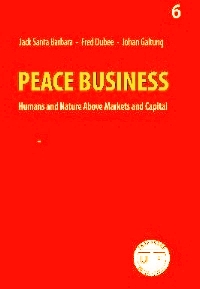
Couple this with Peace Business: Humans and Nature Above Markets and Capital which I noted in a recent blog, and one can awaken to the possibility of a world without war and violence.
 Peace Business - Humans and Nature Above Markets and Capital Peace business starts from a different orientation - not solely on making a profit but on meeting basic human needs.
  
"These are human needs in their simplest and most universal form. The basic human needs of future generations are deemed as  important  as those of today's population. This is in contrast to the current business paradigm where profit is the determining factor in whether a good or a service is provided.
     The fundamental distinction between the current business paradigm and peace business is this difference in purpose - meeting basic human needs in a just and sustainable fashion, as distinct from profit. Rather than relying on first generating profit and then leaving it to government or the largess of businesses to redistribute the wealth in a fair manner, peace business sets out to meet basic human needs as its overriding priority."


Surely, ending war will not be easy. Others have been trying for centuries. But slavery took centuries to end, and women and people of color have more rights and power now than they had 100 years ago, while we still have much further to go. All of these efforts began with those who believed in the possibility of changing the status quo.

As McCarthy notes in one of his responses to a student, "When the 40-hour work week was first proposed by Eugene Debs, the five-time Socialist candidate for president from 1900 to 1920 - the idea was dismissed as lunacy. Debs went further. He called for paid vacation for the workers. More lunacy. Then he went too far and urged people to oppose US entry into the first World War.. He praised opponents of the draft. For that, he was sentenced to 10 years in federal prison." (p.126)

We need resilience.
riveting and a real gem, filled with insights gleaned from the thousands of letters he’s received from former students. In it, he explains how and why he went about it, enduring skepticism and praise, criticism and admiration. - See more at: http://historynewsnetwork.org/article/158592#sthash.PXeCPjuG.dpuf
His new book, “Teaching Peace: Students Exchange Letters with Their Teacher,” is riveting and a real gem, filled with insights gleaned from the thousands of letters he’s received from former students. In it, he explains how and why he went about it, enduring skepticism and praise, criticism and admiration. - See more at: http://historynewsnetwork.org/article/158592#sthash.PXeCPjuG.dpuf

As I excerpted earlier this year in a brief discussion of Randall Amster's Peace Ecology,


     "War is a social, economic and ecological disaster. It is totally unsustainable and must be opposed by all who are concerned about meeting the real needs of all people and future generations. The effect of war is most immediate for those who are killed or maimed or made homeless, but the social and ecological consequences reverberate for generations. Among the children who survive, we still don't know the full extent of the psychic damage they have suffered or the degree to which their problems are transmitted to successive generations. War is the ultimate atrocity that dehumanizes victor and vanquished alike; divorcing children from parents, separating families, smashing communities, it deprives its victims of their basic need for love and security in the company of their fellow beings." [David Suzuki, quoted on page 4].


Perhaps we can begin to see the links between violence between humans and violence between humans and nature as two sides of the same coin. If we want to save the home we share with other beings, we must end war. We must. Starting Now. Colman McCarthy, Randall Amster, Johan Galtung, Jack Santa Barbara, Frederick Dubee have given us glimpses of possibilities. We must put our shoulders to the wheel.

Happy Earth Day


Wednesday, April 8, 2015

Enough Already

 How much is enough? What's sufficient? These are questions not much puzzled over in the media or amongst the policy makers, but are arguably at the heart of the two largest challenges facing the human family - growing income inequality and climate and ecological destabilization.

Wall Street Bonuses: A Bottom-Up Take From: Too Much, April  2015


Thanks largely to the Occupy movement and the great work of folks like Sam Pizzigatti at
Too Much

it is now permissible to discuss in public the growing inequality that has been let loose since the actor/governor turned president road into Washington to "drown government in the bathtub".

Excessive - more than normal or proper

Exorbitant - exceeding the appropriate limits

Extravagant - exceeding the limits of reason or necessity

 Any of these words can be easily used to describe the growth in personal wealth unleashed since the 1980s.

The data is now so common as to be known by most of those inhaling and exhaling on a regular basis amongst us. Even the acceptance of those facts seems to be widespread and recognized as undesirable. Yet the resistance to remedies persists. Part of this cognitive dissonance is the result of the ether of our popular culture that we inhale daily, that makes us think we can simply grow our way out of this, as if we live on an infinite planet with infinite resources. Clearly, I don't think a PhD or even an high school education is necessary to recognize that, those with great wealth have more power - not just economic power, but political as well as media power. See Unheavenly Chorus: Unequal Political Voice and the Broken Promise of American Democracy if you doubt this for even a millisecond.
bookjacket

As I noted in a blog from last summer the highly recognized work by three leading political scientists provide 693 pages of evidence. Their evidence is compelling, but If that wouldn't provide sufficient research evidence try this.

"According to a new study from Princeton University, American democracy no longer exists. Using data from over 1,800 policy initiatives from 1981 to 2002, researchers Martin Gilens and Benjamin Page concluded that rich, well-connected individuals on the political scene now steer the direction of the country, regardless of – or even against – the will of the majority of voters. America’s political system has transformed from a democracy into an oligarchy, where power is wielded by wealthy elites." So reports Ellen  Brown, founder of the Public Banking Institute in a recent post, "How America Became an Oligarchy"

http://d3n8a8pro7vhmx.cloudfront.net/pbi/sites/1/meta_images/original/PBI-weblogo.jpg?1412977909

That this is true both within and beyond our nation's borders is also clear. If you've gotten this far and your not concerned, then read no further. But if like me you are concerned then consider some of the following possibilities.

1)  My first suggestion runs on sunlight. They say sunshine is the greatest disinfectant. So why not require every enterprise that employees humans to post annually the following information that we might all  see where the money goes:
  • Minimum salary for lowest paid full-time regular employee
  • Median income of all employees
  • Wage ratio from minimum regular full-time to highest paid employee
As citizens/consumers we could use that information in deciding whether to support the enterprise, with donations (nonprofits) or purchases (businesses) or votes (government).

2)    Restore the progressive tax system that was in place before the likes of Reagan, Bush, Clinton, and Bush opened the dikes for their financial supporters. If you want to be real progressive return rates to the Eisenhower days.

3)   Institute a Tobin type Tax on financial transactions. The tax should be regressive in relation to the time the money is held: the shorter the duration the higher the rate of tax. End the speculative instinct for frivolous profit.

4)  Provide incentives for for local purchasing from locally owned enterprises, especially those whose products are made locally and who are good community citizens.

5)   Make all donations to political activity transparent. No more hiding behind false fronts funded by anonymous benefactors.

Next time, an increasing list of "possibilities" for ending the obscene inequality that is destroying our democracy and the unraveling the ecological systems that provide the possibility of human life.

Yes Virginia, there are alternatives. And we've yet to tap the creative potential that lies dormant in the co-intelligence we share.