Attitude of Possibility

Putting
together a 1,000-piece jigsaw puzzle seems an appropriate metaphor for the
challenges ahead of us as a human family. This one took my wife, Ellen, and me,
about a week of coming and going. It was a good activity for some frigid, snowy
days and evenings. We didn’t count the hours, we simply hovered over the table
when the spirit pulled us, either separately or together. We began, as is our practice,
by enclosing the frame or establishing the boundaries. From there it was
looking for connections of color and shape, using the photo on the lid of the
box for clues. It was interesting how many times one of us would hold a piece
and not see where it fit, and the other immediately did. I think this approach
has some merits to our current challenges.
We stand at a critical moment in Earth's history, a
time when humanity must choose its future. As the world becomes increasingly
interdependent and fragile, the future at once holds great peril and great
promise. To move forward we must recognize that in the midst of a magnificent
diversity of cultures and life forms we are one human family and one Earth
community with a common destiny. We must join together to bring forth a
sustainable global society founded on respect for nature, universal human
rights, economic justice, and a culture of peace. Towards this end, it is
imperative that we, the peoples of Earth, declare our responsibility to one
another, to the greater community of life, and to future generations. (Earth Charter,
“Preamble”, 2000)
Nearly
twenty years ago people of many nations came together to produce the Earth Charter that emphasized humanity was at a
critical moment. It was also at the cusp of launching the Millennium Development Goals, and three years later the release
of the Millennium Ecosystem
Assessment. A few trends have been slowed or
redirected, but as recognized when the new Sustainable Development Goals were agreed to by all member states
of the United Nations in 2017, we are losing the race to sustainability on many
fronts in most every nation.

Those 17
Global Goals, with their 169 targets and 232 indicators, give us all much to
do. In their sheer number and breadth it can certainly seem like more than any
of us can comprehend or handle, even if we were to take them each up separately. Thus it might be easier if we could somehow
consolidate them in a useful way without losing the necessary detail.
Unbeknownst
to me and I suspect 98% of the human family, there has been an international
team of scholars wrestling with all of this for years.
Late last
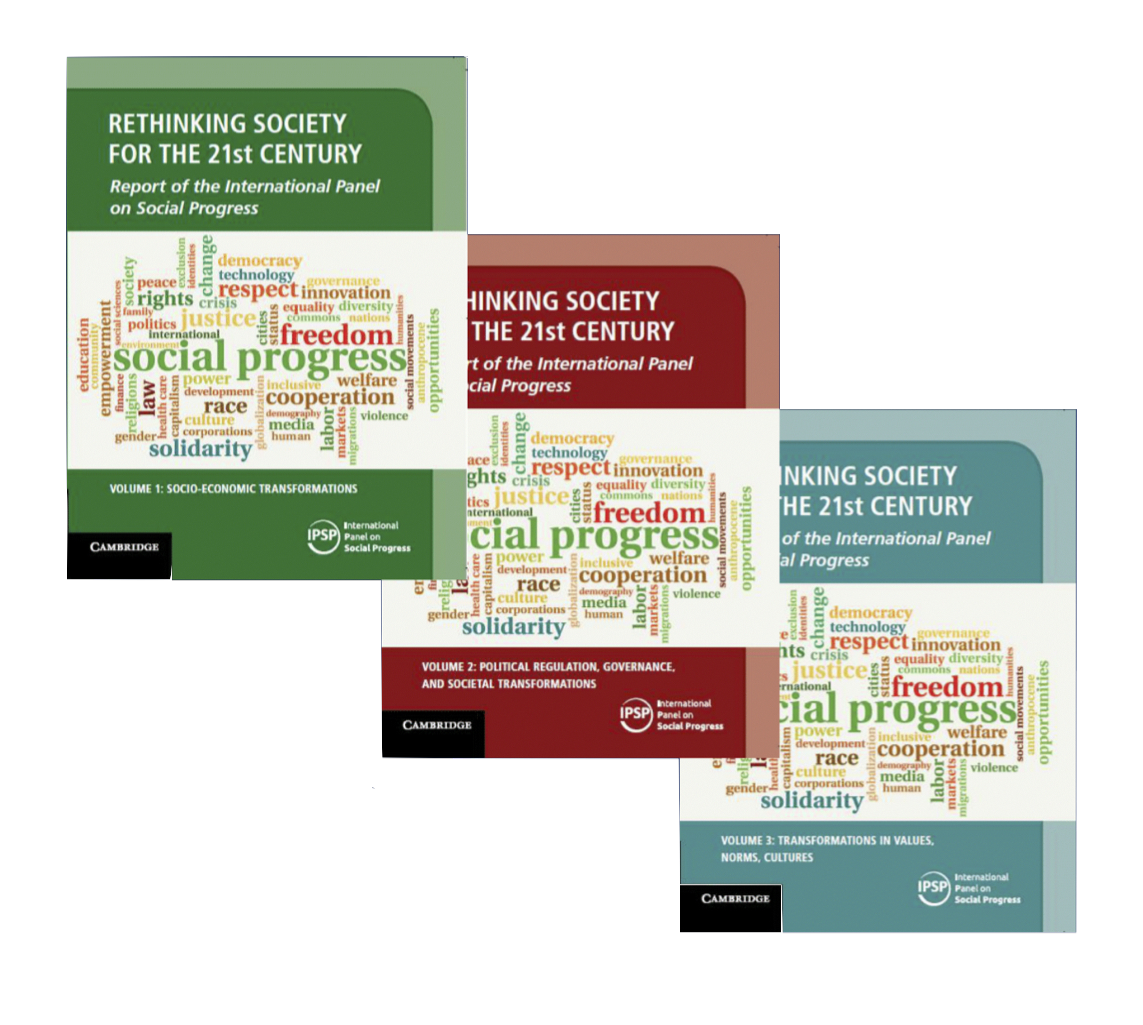
year the International Panel on Social
Progress (IPSP) laid out in much
detail a possible direction to head. IPSP is an international effort of more
than 200 social scientists from every continent representing all the social
sciences to try to find a way forward for the entire human family together. I have not read the three volumes, Rethinking Society for the 21st Century.

In fact, I wouldn’t know it existed had I not stumbled on A Manifesto for Social Progress: Ideas for a Better Society, which is a shorter overview of this
colossal enterprise written by some of the principal leaders of the effort.
“We cannot simply
undertake minor changes, small fine-tuning of policies, and avert the looming
crises. A more fundamental transformation is needed. We believe that this
transformation is possible… Three main goals must be pursued and achieved in
conjunction, and they relate to three fundamental values:
· Equity: reduce inequalities of
development between countries and social inequalities within countries;
· Sustainability: put the planet back on a track that preserves ecosystems and
the human beings of future generations;
· Freedom: expand and deepen basic liberties, the rule of law, and democratic
rights for all populations.”
( A Manifesto for Social Progress, Cambridge University Press, 2018, p.85)
The authors
immediately concede after pointing us in this direction that there will be a
natural tendency to attempt to work on any two of the three goals. They go on
for several pages with scenarios for any combination of two goals sought while
one is missed, whereby all of the scenarios end badly. While there is consensus in the “direction”
the human family should go for true social progress for all, the route they
agree on must be worked out. But even getting our communities to support these
basic three goals would be a huge step forward.

While we
delve deeper into the individual goals we are apt to lose the importance of
their collective wholeness. Recent revival of interest in Goethe’s notion of “wholeness” in nature shows some hope that we might begin
to grasp its importance, that in focusing on the parts we miss the whole. Scientific reductionism has led to many
important breakthroughs, discoveries, and new understandings of our world and
our place in it, but it has left in its wake an increasing array of largely
unintended consequences which we are handing down to current and future
generations to struggle with – ecological destabilization and extreme
inequality being two prime examples.
Sociologist,
Michael Schwalbe, wrote what I believe is a sadly overlooked book about change,
especially as it addresses inequality: Rigging the Game: How Inequality Is Reproduced in Everyday Life (Oxford University Press,
2008). ( A new edition was published in
late 2014, which I have yet to read.)
Following a
long dissection of how the existing rules further increase inequality, Schwalbe
offers in his final chapter, “Escaping the Inequality Trap,” a few possibilities.
Of course one
danger of diagnosing a problem is
the possibility of discovering that it has no solution. No doubt some readers
feel this way about the persistence of inequality. It might seem that the game
is so securely rigged that it can’t be changed. But then history should tell us
that this is not true; the social world is always changing (just look back and
see where we came from). What’s more, the only thing worse than a grim
diagnosis is no diagnosis at all, because then you have no idea where to look
for a solution.
In previous chapters I’ve shown where some of the
problems lie. Now I want to use that analysis to suggest how inequality could
be greatly reduced, if not (yet) abolished entirely. I don’t mean that I can
offer a blueprint for change. But what I can do is to suggest, in general
terms, what needs to be done to nudge change in the direction of equality
rather than away from it. If we can see what holds inequality in place, we
ought to be able to figure out something about how it can be shaken loose.
Schwalbe
believes that a key starting place to replace the rules of a rigged game begin
with “freeing the imagination”:
The problem, from the standpoint of trying to change a
rigged game, is getting a critical mass of people to believe that change is
possible and that better alternatives can be created. If only a handful of
people venture to imagine alternatives, TINA (There is No Alternative) will
prevail and the rigged game will go on.
That’s why people interested in analyzing the status quo and thinking
about alternatives form communities in which to share ideas and information.
That is what happens, or is supposed to, in colleges and universities and in
social change organizations. The problem, from the standpoint of elites who
want to preserve the rigged game, is keeping ideas that challenge TINA from
catching on beyond a handful of activists and intellectuals. (pp. 241-2)
Schwalbe
also argues that two other conditions must be established if the rules of the
rigged game that have given us increasing inequality are to be revised -- humanizing
others and questioning contradictions. As long as we see others as
distinct and not connected to our situation we will be all too likely to ignore
their suffering and will not be inclined to work to alleviate it or its causes.
If we could think of others as family, the likelihood is we would roll up our
sleeves to help address the suffering. Similarly, he notes, “Imagination is often driven by questions,
especially those of the What if? variety. Such questions tug our minds beyond
the confines of the ordinary and familiar.” (p.244)

In his book, Imagining
the University, emeritus
professor of higher education Ronald Barnett (University of London) calls on us
to reconsider a feasible utopia and to place the idea
of the university within it. Barnett lays out the need for such ”freeing the imagination”
exercise, challenges the recent and dominant ideas of a university, and
provides the scaffolding for constructing approaches to the positive
possibilities that are called for as the human family stares into
an increasingly complex and fragile future.
Ideas of the university in the public domain
are hopelessly impoverished. 'Impoverished' because they are unduly confined to
a small range of possible conceptions of the university; and 'hopelessly'
because they are too often without hope, taking the form of either
hand-wringing over the current state of the university or merely offering a
defence of the emerging nature of 'the entrepreneurial university'....
Why does this matter, and why does it matter at this particular time? At the very moment when the idea of the university should be opening out, it seems to be closing in, at least in the public imagination. The idea of the university has, of course, undergone many shifts and been subject to varying conceptions over time. For some hundreds of years, the idea of the university was - as it might be said - that of the metaphysical university, reflective of inquiry that enhanced humanity's connections with God, or the Universe, or Truth, or Spirit, or even the State. That conception gave way to the research university, which is now giving way to that of the entrepreneurial university, which in turn is closely allied to the emergence of a tacit idea of the corporate university.
What is striking about this conceptual journey that the idea of the university has undergone - over nearly one thousand years - is that it has gradually shrunk. Whereas the metaphysical university was associated with the largest themes of humanity's self-understanding and relationships with the world, the idea of the university has increasingly - and now especially in its entrepreneurial and corporate incarnations - closed in. The entrepreneurial university is expected to fend for itself, and attend to its potential impact on particular segments of the economy, and become distinctive. This university has abandoned any pretence to be associated with universal themes.
The idea of the university has closed in ideologically, spatially and ethically. Ideologically, the contemporary envelope of ideas encourages the university to pursue quite narrow interests, particularly those of money (in the service of a national - or even a global - knowledge economy); spatially, the university is enjoined to engage its region, especially with industrial or business organizations in its environs (increasingly its students are also 'local'); and ethically, the university has become focused on its own interests. It will, as a result, close departments of chemistry or physics or modern languages or philosophy because it sees such closures as serving its own (usually financial) interests rather than their being laced in a set of public interests. (pp1-2)
Why does this matter, and why does it matter at this particular time? At the very moment when the idea of the university should be opening out, it seems to be closing in, at least in the public imagination. The idea of the university has, of course, undergone many shifts and been subject to varying conceptions over time. For some hundreds of years, the idea of the university was - as it might be said - that of the metaphysical university, reflective of inquiry that enhanced humanity's connections with God, or the Universe, or Truth, or Spirit, or even the State. That conception gave way to the research university, which is now giving way to that of the entrepreneurial university, which in turn is closely allied to the emergence of a tacit idea of the corporate university.
What is striking about this conceptual journey that the idea of the university has undergone - over nearly one thousand years - is that it has gradually shrunk. Whereas the metaphysical university was associated with the largest themes of humanity's self-understanding and relationships with the world, the idea of the university has increasingly - and now especially in its entrepreneurial and corporate incarnations - closed in. The entrepreneurial university is expected to fend for itself, and attend to its potential impact on particular segments of the economy, and become distinctive. This university has abandoned any pretence to be associated with universal themes.
The idea of the university has closed in ideologically, spatially and ethically. Ideologically, the contemporary envelope of ideas encourages the university to pursue quite narrow interests, particularly those of money (in the service of a national - or even a global - knowledge economy); spatially, the university is enjoined to engage its region, especially with industrial or business organizations in its environs (increasingly its students are also 'local'); and ethically, the university has become focused on its own interests. It will, as a result, close departments of chemistry or physics or modern languages or philosophy because it sees such closures as serving its own (usually financial) interests rather than their being laced in a set of public interests. (pp1-2)
Barnett argues that "imaginative ideas
of the university are in short supply and that there are - if only
embryonically - many ideas of the university close at hand."
He claims that the powers that be resist opening it up to alternative ideas.
While his aim is specific to the idea of the university, I find his insights
into the usefulness of imagination and the birthing of new ideas particularly
compelling. In fact, the need to use his approach for rethinking our economic
and political systems in the face of globally shared dilemmas seems perhaps
even more essential at the moment.

As has been my
practice for a few years, three years ago (almost to the day) I was browsing
the new-book shelf at my university library-- they shelve perhaps 100 new
titles a day and leave them up for a week. So my chances of even seeing them
there is quite iffy. And I certainly don’t look at every book. I skim by call
number (subject) and then by title. The title of one paperback that
caught my attention was Change Everything.

It was classified
in economics. As I pulled it off the shelf and opened it, I discovered
the subtitle that convinced me to give it a chance: Creating an Economy for the Common Good. Part
of me was resistant to try yet one more economics book as there are now close
to two dozen I have consumed in the past few years. I had never heard of the
author, Christian Felber, although it became apparent from the back cover that
he was a European economist. One quote claimed Felber “is one of the most
brilliant economists in Europe.”
Well, I get this
far with lots of books. But after reading the rest of the salutary blurbs, a
few from names I knew and respected, and reading the forward and his preface, I
determined that this was at least worth some investment of my time. Felber, it
turns out, is an Austrian economist who writes in German. So the book in my
hands was a translation by Susan Nurmi. Boy, am I glad she agreed to do this!!
As is my inclination, especially in fields where I have some reading
experience, I like to glance at the bibliography to see whom the writer reads
and cites. While there were a few economists in English I was familiar with –
Herman Daly, Tim Jackson, E.F. Schumacher, Leopold Kohr, Elinor Ostrom, Thomas
Picketty, Milton Friedman--the majority were from German and French authors I
was unfamiliar with, a real bonus.
As he says early in
his preface, “One of the main objectives of this book is to
demonstrate, in concrete terms, that there are in fact alternatives to the
current economic order” (p. xiv).
But this is not
simply a checklist of what we might do to create an economy for the common
good, although there are plenty of specific examples already shared in the
book. This is a deeply reflective analysis of why we have the system we
have. Felber clearly examines the supposed tenets of our current
system and then shows how they are responsible for the shortcomings we see all
around us.
Felber then begins
to construct an alternative set of tenets, shoring them up with evidence of a
better outcome employing a systemic understanding of the interaction of the
principles and practices. At the foundation is, of course, a discussion of key
values. And it is here the wrestling match must begin with those who believe
the system we have only needs a little tweaking to repair the damages that have
resulted from its application. As Felber makes clear,
Two
crucial questions pose themselves: what does the “common good” mean and who
defines it? As a guiding concept, the Economy for the Common Good has no preconceived
meaning except that it signifies how important the well-being of all human
beings and the natural world is… the only immanent meaning of the common good
concept is that everyone’s well-being counts. Otherwise the concept constitutes
nothing more than an umbrella term in the sense of a constitutional goal which
sums up the key values of democratic societies. The precise meaning of its
individual components can and should be determined democratically. The “common
good” is neither divinely handed down nor does it derive from the grace of any
emperor.
It should be clear
that Felber doesn’t see the system he envisages as some detailed system
designed by experts but rather a direction driven by local democratic processes
upon shared values. He has a whole chapter on ”advancing democracy” which is
central to his thesis. Following that is a chapter on real world examples, and
concluding on how we might ”put it into practice.” He begins that last chapter
with this quote from Buckminster Fuller:
“You never change
things by fighting the existing reality. To change something, build a new model
that makes the existing model obsolete.”
Felber has not only
given us some refreshing ideas; he and his colleagues have begun to put many
into practice. By the end of 2014 there were efforts afloat in numerous
countries, regions and municipalities involving businesses, government,
organizations and individuals to employ the ideas for an Economy for the Common
Good and the brilliant Common Good Balance Sheet all
businesses and organizations should use to assess their performance for the
common good.

Anyone dissatisfied
with the current state of affairs will be pleased to see that another world is
possible and is being born. You might even want to join the efforts. There is
no better place to begin than with this very important and inspiring book. If
you don’t have the time to read the full book there is a video of a talk Felber gave last year in Amsterdam
that will provide a cursory introduction to ideas and the guy behind them. Although
the video is almost two hours, his
presentation from around 6:00 minutes to 46:00 minutes should give you a clue
to what we could do to replace the madness of our current economy rules.
Felber isn’t alone in imagining a
new set of rules for the economy. Check out some of the following new economy
sites. The possibilities are plentiful!
If there is an author/thinker who always nudges me to rethink
possibilities, to question contradictions, and to see things in a new light
it’s Charles Eisenstein. Charles Eisenstein, who has the uncanny ability to look at the
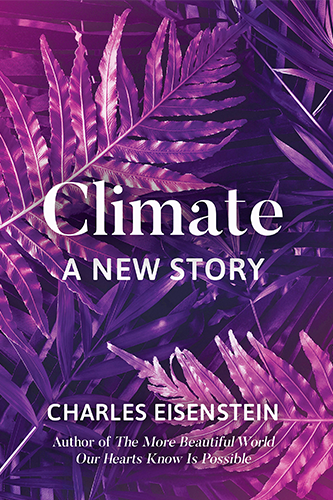
world with fresh eyes, has penned an urgent read in my mind: Climate
– A New Story (North Atlantic Books, 2018).
As
author David Abram writes,
What a blast of sanity! Eisenstein’s corrective is a
bracing piece of work, dazzlingly thorough
and eloquent in its articulation. He writes from within an uncannily woke
worldview, enacting a full-bodies way of thinking that discerns and feels into
the complex entanglement of our lives with every facet of this breathing
biosphere. This book is visionary and prophetic, achingly grounded and useful
to the max.
As Abrams suggests,
it is packed with perspective you just won’t find anywhere else. I stumbled
upon Eisenstein when he was speaking at a conference I attended in 2012 where
he spoke on “We Are Relationship: The Transition to a Collaborative Society.” I
was stunned at the wisdom oozing out of this guy and immediately ordered Sacred Economics, which he had just published. It was indeed, like his talk,
transformative.
This book has a
similar feel but comes to us from concerns with the climate as the North Star
for thinking about how we might address our human predicament. He begins with a
look at the spectrum of how folks think about climate change, from what he
labels “Climate catastrophism” = we’re doomed and it’s too late, to the other
end, “climate skepticism” = that it’s not happening, or if it is happening it
has little to do with human activity, or if it is attributable to human
activity, it isn’t dangerous. Eisenstein looks under the covers of all of these
points of view. What he suggests is truly eye opening.
As one reviewer notes,
Flipping the script on
climate change, Eisenstein makes a case for a wholesale reimagining of the
framing, tactics, and goals we employ in our journey to heal from ecological
destruction. With research and insight, Charles Eisenstein details how the
quantification of the natural world leads to a lack of integration and our
“fight” mentality. With an entire chapter unpacking the climate change denier’s
point of view, he advocates for expanding our exclusive focus on carbon emissions
to see the broader picture beyond our short-sighted and incomplete approach.
The rivers, forests, and creatures of the natural and material world are sacred
and valuable in their own right, not simply for carbon credits or preventing
the extinction of one species versus another. After all, when you ask someone
why they first became an environmentalist, they’re likely to point to the river
they played in, the ocean they visited, the wild animals they observed, or the
trees they climbed when they were a kid. This refocusing away from impending
catastrophe and our inevitable doom cultivates meaningful emotional and
psychological connections and provides real, actionable steps to caring for the
earth. Freeing ourselves from a war mentality and seeing the bigger picture of
how everything from prison reform to saving the whales can contribute to our
planetary ecological health, we resist reflexive postures of solution and blame
and reach toward the deep place where commitment lives.
Given my own
work in recent years it would be especially remiss of me to ignore the specific
emphasis Eisenstein offers in the last of his suggested policies and changes he
urges us to pursue: Demilitarize
society.
The environmental crisis invites us to change our priorities
and put earth healing first, make ecological-social healing the primary
conditioning parameter on every political
decision. The military mind puts defeat of the enemy first instead. More
tangibly, the military sucks up prodigious amounts of energy, materials, money,
and human talent. Tens of thousands of the best scientists and engineers devote
their lives to developing weaponry. Millions of healthy, capable, idealistic
young people join the military. And of course, the money squandered on weaponry
is enough to fund probably all other proposals in this book. (p,276)
For a video interview with Charles
that explores his ideas see here.

In recent
months, an example of this kind of possibility thinking has come forward in the
proposal for a Green New
Deal. Like the International Panel on Social Progress it points
direction not the route. It addresses several of Sustainable Development Goals
at the same time. It is based upon freeing the imagination, humanizing others,
and questioning assumptions. In short, it has the spirit and attitude of possibility.
The point of
this blog has been about conjuring up new ideas and possibilities that might
nudge us all toward a better life on a single, finite, and magical planet
together. There are no certainties. We really don’t know what is possible until
we try. What each of these authors has led me to believe is that there is some
deeper harmony between reason, emotion and intuition that makes us human. When
we tap it all and find other voices to deepen the harmony we’re better off.
Speaking of
harmony, if you don't
believe change is possible, the story of Playing for Change that started simply with a videographer finding
street musicians in various places around the world and then connecting them is
a moving antidote to that hardening of the mental arteries. This initial
travel experience has now evolved into a global band with live performances and
into an inspiring launch of music schools in the developing world. If the story
doesn't move you, the music should.
Perhaps the anthem
for the new age is best represented in one of the Playing for Change Band's
version of this song, "A Change is Gonna Come.” Or this just released, “Seeds of Freedom.” Change is inevitable, so be the change you want to see in
the world. It's possible!!!