Showing posts with label Kate Raworth. Show all posts

Sunday, February 14, 2021

So Tired of Playing Defense


I’ve been moving myself through Gar Alperovitz’s stunning 1995 The Decision to Use the Atomic Bomb and the Architecture of an American Myth for the past month or so. This 843 pager (48 chapters plus appendices) with more than 2,600 footnotes is a compelling historical detective work. I’ve completed the first 46 chapters and 588 pages.

The 2,600+ notes do not include additional author notes sprinkled every few pages. It was one of these that led me to check out yesterday The Price of Vision: The Diary of Henry A. Wallace 1942-46 (edited by John  Morton Blum) and published in 1973. This is no lightweight volume either, coming in at 707 pages. One of the appendices that Blum adds is a speech, “The Way to Peace” that Wallace gave in September 1946 at Madison Square Garden that led to his firing by Truman.  Wallace was by all accounts a unique and interesting figure. One can’t help but wonder what the world would look like now, had not Roosevelt substituted Truman for Wallace as VP in 1944.

I read that 1946 speech and then a few minutes later read a report in a defense industry post I receive each weekday morning about the addition of a U.S. joint aircraft carrier strike force into the South China Sea. Wallace might have been a bit too idealistic in 1946 about the Russian threat, but the analysis he offered then, seems strikingly similar to the forces at play today. My concerns that President Biden’s administration would continue the militarism of the previous administrations suggests we are on the same conveyor belt which Wallace objected to, which benefits primarily weapons manufacturers. Even Eisenhower who was critical of that same force as most forcefully demonstrated by his farewell address, was controlled by it.

Who in government is willing to call it out today, besides a few members of the Progressive Caucus (see the new Defense Spending Reduction Caucus)? Biden’s cabinet selections on the foreign/military policy side are no doubt loyal to him and have largely hawkish resumes. If they dare to publicly speak otherwise, they would no doubt suffer the same fate as did Wallace 75 years ago. We need some courageous souls within government to call this out.

Many of us have been pushed into defensive postures over the past four years by attempts to dismantle American democracy. It has drained the energy of many. We might be tempted to relax our postures with the election of a liberal to the executive branch, but some myths of American exceptionalism die hard. While we must defend  against continued theft of our common wealth by the drivers of the corporate military-industrial complex, it is equally important that we offer real alternatives. As I have reflected in this blog frequently over the past, there are alternatives.

Let me offer one sterling example. The London School of Economics shared a wonderful webinar on Friday, featuring the amazing economist Kate Raworth, author of Doughnut Economics, which I have reviewed on more than one occasion. Listen attentively to her present a real alternative, now being adopted and applied in places around the world. She’s not a dogmatist. This is a framework that makes total sense with what we know about our world today. As we learn more, we may need to shift and adapt it, as she readily admits. But the possibility for a better world for all is there if we will look, reflect, and act to as Jean Luc Picard might say, “Make it so.” 

 https://www.youtube.com/watch?v=ku4AV2Ummq0


Sunday, May 7, 2017

Oldies But Goodies

There is probably a built in mechanism in our culture's brain that the newest ideas and thoughts are better than older ones. Today's thinkers have the chance to stand on the shoulders of those who came before. I know I'm always looking for fresh new ideas in the books recently published, thus my almost weekly visit to the new book shelves at the Michigan State University Library. One doesn't have to travel far to recognize that some older works, many obscure except to a few readers, offer great insights usable today. That's why we read some of our more famous thinkers like Aristotle, Shakespeare, Plato, Darwin, Locke, etc.

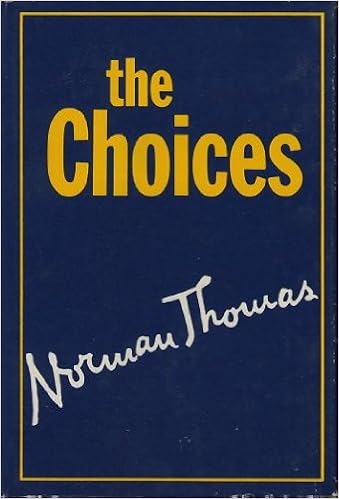
So I stumbled into a few terrific reads from the 1968-69 era within the same week. They were inspired from different sources. The first one I completed last week. Simply titled The Choices, it was the final book of Norman Thomas' life. He completed it a month before his death at age 84 in December of 1968. Thomas was a remarkable figure of the 20th century from his early involvement against the first world war to his fight against American imperialism, inequality, and racism right up to his death. A Presbyterian minister, socialist, pacifist and six time presidential candidate from the Socialist Party, Thomas was considered one of the most powerful orators of his time. Having read and blogged on his biography last December I was compelled to find and read a few of his own writings. One of them was The Choices.


It is a short, small book not quite 90 pages in length. Kirkus Reviews noted in an early 1969 review that

          Here, in his last political credo, Thomas reiterates his democratic socialism. But except on the issue of "universal disarmament" with UN control, almost any American will accept his views. The prescriptions stress flexible social planning and regulation of air and water pollution, natural resources and the birth rate. He advocates abolition of the electoral college, but pointedly scores the New Left for its "apotheosis of violence." The issues of racism, poverty, civil liberties and war also receive scrutiny. Throughout, Thomas indicates the choices he favors for deciding the world's future.

There is a quiet gentle wisdom in this book. I find it amazing that his many political defeats failed to make him bitter or cynical. 


        "I made my first important speech to a large audience in Madison Square Garden in 1917, in support of Morris Hillquit, the very able Socialist Party candidate for mayor of New York. The meeting dealt largely with the First World War, our entrance into which the Socialists had opposed. To fashion a world without war seemed to me a primary concern. I also believed that to attain peace, the world would have to concern itself with creating a world in which social justice prevails."

         Almost fifty years from that day, I made what tuned out to be my last speech in November 1967. I spoke before a large audience of labor leaders in Chicago. Once again, the subject was peace. After fifty tumultuous years, years which saw victory for what was the better side in two world wars, the United States was involved in a very cruel war in Vietnam, and living under the constant threat of a third world war.
         ... I am very critical of what is now called the Establishment in Washington, Moscow, or Peking, but I have great affection for my own country and confidence -- especially with the oncoming generation -- in its salvation. To use symbolic terms, I am one of those who desire to wash the flag, not burn it. I recognize that washing the flag requires more than political or economic group action. It requires personal action, your action in the ending of violence, the achievement of fraternity and honesty."

His chapter titles gives a good hint of what he addresses:


  1. We Must Choose Peace
  2. Racial War or Racial Fraternity?
  3. Toward Racial Fraternity
  4. Economics I: Economic Justice
  5. Economics II: The Choice of Means
  6. Economics III: Some Further Questions
  7. Toward Civil Liberties and Civil Rights
  8. Toward Violence of Non-Violence
  9. The Electoral Process 
  10. Political Action 1968
It's hard to think of anyone of similar stature for our times. A voice that challenged the status quo with fervor, eloquence and passion. He may well have left us almost fifty years ago, but his ideas live on and are as timely as any written today.

The second book was referenced in a footnote of something I read recently. The context of the citation, which I also can't recall, made it seem worth looking into. As it happens so I found an old paperback copy of the book on our bookshelves. One of those books you might find at a used book sale but never get around to reading. I have quite a few more of these!

Michael Harrington was half Norman Thomas' age when he wrote Toward a Democratic Left: A Radical Program for New Majority in 1968. 

Toward a Democratic Left: A Radical Program for a New Majority

It is a longer and more scholarly approach to similar contemporary issues. Like Thomas, Harrington was a socialist and went on to form the Democratic Socialists of America which he led for a number of years before his death in 1989. He was most noted for writing The Other America which was credited with inspiring President Kennedy and Lyndon Johnson into creating the Great Society. He won the prestigious George Polk Award for that earlier work. Unlike Thomas who believed in changing the system through the Socialist Party, Harrington believed that one had to work through the Democratic Party and that appears to be the focus behind this book.


I am only 50 pages into this 300 page tome so it's much too early to cast a final judgment on it. But early on I admire the temperament and the insights that again are so pertinent to our own times.

        "The old liberalism does not offer an adequate response to these massive historic trends and can even be used as a screen for corporate collectivism.  As long as new Leftism is only an opposition it may help people to change masters but not to free them selves. To deal with the crises it has officially certified at home and abroad, the United States will have to be quite concrete. It must, among other things, redefine economics, recover its passion for equality, and, in the doing, reduce the profit motive to fourth rate importance and raise the non-profit motive to the first rank." (p.17)

        "In short, there must be a social determination of what is economic. Building homes for the impoverished is not profitable from the point of view of a corporate investor because it does not provide a high enough rate of return on capital. But the social investor -- which is to say the democratic society -- has a different point of view. Poverty is, of course, enormously costly in terms of increasing the risks of crime, fire, disease and every other ill, and America already pays a high price for being unjust. But much more basically, human beings are being squandered, and this is a tragic waste from the point of view of both the individual and the society." (pp.20-21)

       "Yet these relatively functional concepts of money making are a far cry fro,m the profit mythology which is still taught to innocent school children in our society. For Americans are told that buying cheap and selling dear, gaining and advantage over one's neighbor, making a killing out of a rise in the value of stock or land which the individual did nothing to promote are the basic principles which should guide the citizen and the society. It is indeed a 'somewhat disgusting morbidity' that the country reverences." (p.26)

        "But homilies will not change the motivational structure of an entire society. What is needed in addition is action to create an environment in which it is more 'natural' to help one's fellow man than to profit from him." (p.26)

Harrington was first a believer in democracy and then a socialist as one can see in his explanation of the difference between an Adam Smith economic view and one of John Maynard Keynes

       "The next giant stride in American life will make Keynesianism social rather than Adam Smithian. This is not, let it be noted again, a proposal for democratic socialism. For it is possible for the people to insist that public moneys be spent on public purposes without changing the fundamental relationships of ownership in America. It is just when tax funds are used to support major transformations of society, the decisions should be democratic ally debated and decided on." (p.50) 

All this leads me back to kind of thinking we see in Kate Raworth's Doughnut Economics that I wrote about ten days ago. It is amazing how quickly and how widely the ideas she has shared in a book that's been released for less than two months has received from other big thinkers. Last week we saw David Korten lead off his review of the work in Yes Magazine with these glowing remarks:

       "I see a lot of books presuming to explain what’s wrong with the economy and what to do about it. Rarely do I come across one with the consistent new paradigm frame, historical depth, practical sensibility, systemic analysis, and readability of Doughnut Economics by Kate Raworth. Especially unique and valuable is her carefully reasoned, illustrated, and documented debunking of the fatally flawed theory behind economic policies that drive financial instability, environmental collapse, poverty, and extreme inequality."

It is clear to this reader, that we need to revisit ideas that were floating around years ago and meld them with the ideas that are emerging about how we move forward as one human family, on a single planet with one future. 

Thursday, April 27, 2017

Good Jobs, Militarism and Doughnuts

I've spared any regular readers, both of you, from any drainage from my mental swamp for over a month. No real fancy reasons, just The MUSE has not visited despite having completed several good new books and lots of activism. And despite the current absence of The MUSE I feel compelled to put down a few words after hearing another pile of crap on NPR this morning.

It was some trite reference to the proposed Trump tax overhaul that will create "good jobs". I would love to hear what those in the Trump administration really define as a good job. For the Chamber of Commerce and its supporters it likely means jobs that pay as little as possible, which largely includes a growing trend of part-time and temporary work. Clearly, the takeover of higher education by the neoliberal faithful, has seen the increasing trend towards adjunct/non-tenured faculty. That lack of sufficient income coupled with non-existent job security make many a PhD a losing financial investment.

Of course, the 1% are doing exceptionally well with this formula, as the income gap between them and the rest of us grows, with no sign of slowing. If you don't quite have a handle on how this has been happening I refer you to a quick, poignant, readable new book from Senator Sheldon Whitehouse: Captured: The Corporate Infiltration of American Democracy. Whitehouse walks through a series of chapters assessing how the Corporate capture has exercised its control of elections, regulatory agencies, courts, and even the citizen jury. As a former Attorney General he's experienced with their efforts at both state and federal levels. Based on this tome and his actions as a Senator I hope his name can someday reside in that mansion on Pennsylvania Ave.

Captured

I have spent a sizable portion of my time since my last blog entry immersed in both studying the hold of militarism on our democracy and organizing to push back against the unquestioned growth and expanse of the the U.S. militarization juggernaut. Where is the politician willing to question the unrelenting growth in military spending? Katrina Vanden Heuvel, editor of The Nation addressed part of this question earlier this week in her column Where is the Elizabeth Warren or Bernie Sanders of Foreign Policy?  Prof. Rebecca Thorpe shines the light on part of the issue in her 2014 study of The American Warfare State: The Domestic Politics of Military Spending. Among other findings is pursuit of making rural and semi-rural areas dependent on military sector jobs and funding that then secures the votes of the elected officials that represent those areas.
The American Warfare State


Nowhere is this more evident than in my own backyard. Michigan two Democratic senators, Debbie Stabenow and Gary Peters, along with every Representative from the state except Republican Justin Amash has signed on to a letter to the Pentagon begging for Ft. Custer (Battle Creek, MI) to be home for a third, but unrequested Ground-based Midcourse Defense (GMD) system. The $3.2 billion dollar boondoggle, besides being unrequested is for s system that fails as often as it has been successful, and that's even with the foreknowledge of when and from where a missile is being launched. The Union of Concerned Scientists recent report drills holes all through the arguments that such system isn't worth the paper it is written on. But politicians need to bring home the pork, regardless of how it smells to the rest of us. Studies show that if you want to create plentiful and good jobs investments in education, green technology, infrastructure or health are significantly better options than military spending.

Rep. Barbara Lee, the only courageous congressional member to vote against the Authorization to Use Military Force (AUMF) after the 9/11 attack has remained an almost solitary voice of reason. Unafraid to stand alone among her peers in calling out the propensity to use violence to solve conflict. Fear seems to be the modus operandi of the neoliberal/militarists who stand up and raise new fears if we don't fall in line for their calls for more... more tax cuts for the wealthy, more military spending, more military bases (see the Nick Turse piece today on The US Military Moves Deeper into Africa, or more military actions.

Meeting with the staffs of our senators, and in one case a Representative himself (Rep. John Moolenaar)  all my elected federal officials seem to either buy-in to the American Exceptionalism mindset, or are too timid to challenge it and the militarization of our society. They are as Sen. Whitehouse makes clear - captured!

So, in a really fresh analysis of our many global challenges steps British economist Kate Raworth. Her new book based upon earlier  work she did with Oxfam not only briefly maps the growth of the neoliberal idea, she notes its many failures while offering a sober and hopeful alternative. Doughnut Economics: 7 Ways to Think Like a 21st Century Economist. 

Doughnut Economics

uses the simple graphic of a doughnut to help us realize that economics should ideally guide us towards the safe space between planetary and social boundaries. If we live outside either boundary we are destined for disaster, some of which we can see already.


Raworth doesn't claim to have all the answers,  but her argument to redirect the economy to work for all of us without destabilizing the natural world systems that make life habitable is worth consideration by all. She builds on the economic theorists that preceded her and gives credit to many working in the field who have helped shine the light on the fallacies of the neoliberal economic model so much in control today.

Good jobs - jobs that proved a livelihood while nurturing the social commons and respecting planetary limits are the kind of jobs we need. If we did it right, we might all have to work a little less, enjoy it more, and remove the drivers that feed militarism and dominance in our world.