Showing posts with label nuclear weapons. Show all posts

Sunday, August 6, 2023

Lest We Forget

Seventy-eight years ago today the US launched a new world with the dropping of an atomic bomb on the residents of Hiroshima Japan. That legacy is pulsing today as the nuclear weapon states – US, Russia, France, Britain, China, India, Pakistan, Israel, and North Korea fail to discuss steps to reduce the number of weapons and threaten their use. The newly released film “Oppenheimer” gives a hint at some of the deliberations that went into developing and using the bomb, but if you want a real ring side seat, there is nothing better than Gar Alperovitz’ The Decision to Use the Atomic Bomb. In the three-hour film, there are few minutes devoted to that decision and all the players involved in it, but one who reads Alperovitz account will see the seeds of current global affairs germinating in that decision.

One might hope that the popularity of “Oppenheimer” combined with the increasing threats posed by the Russia vs. Ukraine/NATO conflict, might trigger more sane minds to work to reducing the nuclear arsenals and the conditions that might even inadvertently spark their use. That’s surely at the forefront of the Veterans for Peace restoration of the ship “The Golden Rule”, which attempted to disrupt testing of nuclear weapons in the Pacific during the 1950s. Actions like this Quaker nonviolent direct action did eventually lead to the halting of atmospheric testing of nuclear weapons. Nonviolent direct action works!!

The current crew of the Golden Rule that has sailed up the Mississippi into the Great Lakes will be in Michigan this week with a stop at the Quaker’s Red Cedar Friends Meeting House in Lansing on August 15th at 6:30p.m. to help us consider how we could work to meet the goals of the Treaty on the Prohibition of Nuclear Weapons (TPNW) – their elimination. While we’ve have been lucky to date that these weapons of mass destruction have not been unleashed since Hiroshima and Nagasaki 78 years ago, they continue to rob our treasuries of billions of dollars that might be used to address hunger, health care, climate change or any of the other threats to our prosperity. The U.S. alone, under both Republican and Democratic administrations plans to spend nearly $1 TRILLION on the weapons over the next decade. What a huge waste of our resources –financial, human, and environmental.

There is barely a pittance spent on negotiating arms control or elimination of the weapons and rarely do we hear anything from our Washington officials even calling for more efforts to reduce the weapons, only more money to build more and newer weapons. This has just played out again in the recent National Defense Authorization Act passed in different versions by each house of Congress. But they both believe in shoveling more money for building and maintaining these scourges of humanity.

Just at the brave crew of the original Golden Rule attempted to sail into the testing zone in the Pacific to halt the testing of these hideous weapons, we must find the courage to speak out and make the abolition of these weapons a focus for the U.S. government that is responsible for unleashing this sword of Damocles on the life of our planet. Silence is not an option. Please urge your members of Congress to support H. Res. 77 “Embracing the Goals and Provisions of the Treaty on the Prohibition of Nuclear Weapons.”


Tuesday, June 12, 2018

Nuclear diplomacy in the age of Trump


TrumpKim

Less than twenty-four hours since Mr. Trump and Mr. Un shook hands, many pundits are critical of  the outcome. I am certainly no fan of  either of these two national leaders. Trump defines arrogance and narcissism as well as any public figure. His braggadocio is so untethered to reality that it's difficult to believe anything he says (or tweets).

But, for whatever reason, he has resisted (thus far) a military solution to this vexing problem, and that is a very big deal as we might pause and reflect on the 17 year old war in Afghanistan that has gained nothing for anyone except the arms lobby. I am not sanguine about the possibility of him triggering a military encounter with Iran or some other "evil empire" du jour. The chances of that disaster became higher with the elevation of Mike Pompeo and John Bolton in his administration. But for the moment, he has resisted flexing his military macho side.

It seems pretty obvious that North Korea has had a target on its head since at least the days of George W. Bush's "Axis of Evil" claim. Regime change from the US has been the driver for pursuit of a nuclear missile as a possible barrier to a US led first strike. I can't imagine a sane person, giving that up, especially with the example of what the US did with Qaddafi after he relinquished his nukes. Trump's aversion to building a lasting trust does not bode well for a total denuclearization of the Korean Peninsula. If you were North Korea, would you trust any deal made with Trump? Still, I applaud the diplomatic effort both sides have made. It's better than war!!!!

I certainly would be surprised if we see any movement on global arms reductions, let alone nuclear weapons, during this administration. Would even his pals, the Russians, trust him on a nuclear deal? His former allies, Britain and France, are probably not likely to believe much of what he proposes, especially after last weekend. Diplomacy needs trust to work and the absence of this arrow in his quiver suggests we will have to wait for a later administration to try and resurrect arms control.

But while Trump is clearly a champion of American Exceptionalism, the failure of the Congressional members of both parties to reconsider the sword of Damocles that nuclear weapons hangs over humanity (and all other species we share this special planet with) suggests our political leaders of both major parties suffer from the same toxicity of American Exceptionalism.

The US remains in the global driver's seat of weapons ownership in both nuclear and conventional weapons. As Trump proclaims, others should fear the US for both our military might and our economic power. A perfect example is the threat we use in the UN to hurt any country that doesn't vote with us. While President Obama spoke collegially about global partnerships and even hinted at nuclear weapons reductions early in his administration, he too fell into the muck of nuclear madness, proposing to spend $1.2 trillion over thirty years to rebuild the nuclear arsenal.

We need a statesperson that can get out of the muck and begin discussions with other sane members of the global family on ridding the world of these weapons, not just for lowly North Korea, but with all the nuclear nations - Russia, US, Britain, France, China, India, Pakistan, Israel. As the first and only nation to use a nuclear weapon, we have a special responsibility to lead the world in abolition and destruction of the weapons that are only meant to destroy entire communities and every living thing in them.


Two Nobel-winning nuclear experts say that North Korea shouldn’t be alone in giving up nukes via Two of IPPNW’s founders, Drs. Jim Muller and John Pastore, have begun a dialog with North Korean mission in New York

Where are our political leaders? $1.2 trillion, plus whatever Trump tries to boost the pot with could be used for so many good things. Each of the other eight nations could also redirect their own funds saved from de-nuclearization into their communities to make life better for all. Every candidate for federal office should be forced to answer how they will end nuclear arms. What steps should the US be willing to lead with?

A little less than one year ago, 122 nations of the UN agreed to the Treaty on the Prohibition of Nuclear Weapons. Of course, the nuclear nations either voted against or abstained. How serious can they be about reducing and eliminating nuclear weapons. Words are cheap, but we're not even getting words for global de-nuclearlization out of American political leadership. What a travesty. 

ICAN logo

The folks at the International Campaign to Abolish Nuclear Weapons, winner of the 2017 Nobel Peace Prize call today's meeting "Good for Diplomacy, But Little Substance." 

ICAN’s Executive Director Beatrice Fihn said, “Trump just pulled off the photo-op of a lifetime. Rather than signing an unsubstantial agreement, Trump and Kim should be signing a real document based on international law, the Treaty on the Prohibition of Nuclear Weapons. The Treaty doesn’t tweet, it doesn’t change its mind on the plane home, and can’t have it’s ego bruised. It’s the only comprehensive, verifiable and irreversible way to achieve meaningful nuclear disarmament”.

Since our elected leaders won't lead, we need to join with citizen driven organization like ICAN and our local Peace Education Center to push for getting global nuclear disarmament back on the agenda of our media and the government.

Wednesday, July 19, 2017

A Prohibition Whose Time is Now

On July 7th, the UN passed the Nuclear Prohibition Treaty. A treaty the US will not join any time soon, just as it hasn’t joined many other global agreements including:

·         Convention on Cluster Munitions
·         Ottawa Treaty (Mine ban)
·         International Criminal Court
·         Anti-Ballistic Missile Treaty (Signed, but withdrew in 2002)

As one might expect this UN action by the majority of civilized states goes largely ignored by the press and politicians in the U.S. With President Obama pushing to spend $1 trillion to upgrade our nuclear weapons capacity when we should be reducing it, is the epitome of insanity. Mr. Trump and his hawkish team is likely to up the ante even more given his first budget that asked for an additional $54 billion for military war chest. One of our liberal(?) Senators is a proud co-sponsor of new legislation that will take missile defense systems, literally into the stratosphere – both operationally and financially.

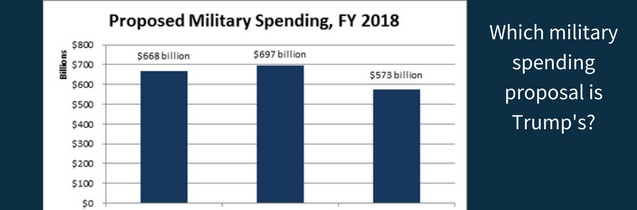
 from the National Priorities Project - go to their site to see the answer

The House passed the National Defense Authorization Act for 2018 before they left for recess two weeks ago upping Mr. Trump’s $54 billion military spending increase by an additional $29 billion. The Senate Armed Services has upped that by an additional $2 billion in what looks like a bidding war to see who’s the most patriotic hawk. There is so much money floating around the Pentagon and associated departments and private contractors that no one even knows where all the cash is. The F-35 is a classic case of a boondoggle that keeps getting more and more expensive and still isn’t in the air. But Pentagon waste is accepted. There is no audit of the Pentagon. As Eisenhower warned, the Military-Industrial-Complex will gobble up money and power from the citizenry, with almost no one challenging the fiscal restraint (Sen. Warren? Sen. Sanders?). Of course, the combined robbing of funds from programs for human well-being and diplomacy and foreign assistance are rarely discussed. And the beat goes on. [see the People's Budget from the Progressive Caucus for an alternative - hint the lowest of three budgets from the graphic above]

That’s why small steps like the Nuclear Prohibition Treaty help put the military juggernaut in the spotlight. A terrific explanation of the treaty and the U.S. position was published in the Washington Post on Monday is an important read “The U.N. Just Passed a treaty outlawing nuclear weapons. That Actually Matters.” By Nina Tannenwald,  director of the International Relations Program at Brown University and the author of “The Nuclear Taboo: The United States and the Non-Use of Nuclear Weapons.”


Without growing and sustained pressure from citizens, Congress will not stand up to the military-industrial-complex, they become part of it. To learn more visit:

Tuesday, August 9, 2016

We Are What We Eat/Read

We took our son, Noah and his partner, Andy, to dinner last night at a new Thai restaurant in Detroit, Katoi. 

The menu was unique to my culinary experience. The mix of tastes and combinations of ingredients was so distinctive, that I could not possibly imagine what these combinations might taste like.
katoi_som_tum_thai_night_test.jpg


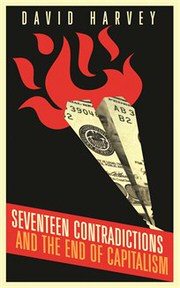
I was struck this morning while reading from two different books on my table: David Harvey’s Seventeen Contradictions and the End of Capitalism (Oxford, 2014) 

Seventeen Contradictions and the End of Capitalism

and Rethinking Economic Policy for Social Justice: The Radical Potential of Human Rights  by Radhika Balakrishnan, James Heintz, and Diane Elson (Routledge, 2016).

Rethinking Economic Policy for Social Justice

Like reading the menu last night, I had no clear picture on what reading from either of these books this morning might taste like. While each of these two books pulled from the pile have some focus on economic policy, they are totally different in orientation and style.

But reading each of them triggered numerous thoughts, including an urge to write something about how the menus of our life change as the available ingredients are in either surplus or scarcity.  Reading this morning took me back to several other recurring thoughts that have seeped into this feeble brain over the past few months.
For instance, while in the actual world the economy is the wholly owned subsidiary of our environment and social world, it is pragmatically dominant to both. Which leads me to believe that solving our inequality and climate change challenges must focus on our economic policies. But as Balakrishnan and colleagues assert, this process must be based upon true democratic process of “public reasoning” to borrow from Nobel laureate Amartya Sen. In spirit, that’s what this blog has had at its heart from the beginning some 200 plus entries ago. Can we consider alternatives,  other “possibilities” to our arrangements that will, in Balakrishnan’s et. al. view, help all of us achieve the human rights that the family of nations has concurred with in the UN Declaration of Human Rights?

Human rights are indeed about individual freedoms. This is a critical aspect of the way human rights frames issues of social justice. But the human rights framework insists that full realization of these rights requires a strong state, international cooperation, and robust social institutions. It recognizes that claiming individual rights demands collective action and responsibility. The human rights approach ensures individual freedoms – including economic, social, and cultural rights, as well as civil and political rights. But there must also be a collective responsibility, exercised through the state, and through cooperation between states for realizing these individual rights. (p.6)

 Other thoughts followed from this including an infatuation I have with the idea of organizing, through some grant assistance, an annual parallel public budgeting process that would mirror the federal budgeting process that beings with the President’s budget release in late January, early February. My idea is that it would transpire over a month or two beginning with a day of looking at existing revenues and expenditures and their trends over time. This overview would be led by  economic and political aware presenters. Following this would by a weekend of a public discussion of values that should guide development of a budget. From this would follow a process akin to Participatory Budgeting where a random group of participants would be selected to draft two or three versions of a “People’s Budget”. These options would then be made available for discussion and vote.

The importance is that this becomes an annual local event. It helps inform the citizenry about the tradeoffs and challenges in allocating resources and collecting revenues. It would subsequently, through media coverage – including of course social media --  impact public policy makers as to the popular will of the people, through a more “public reasoning” process.

Now as I glanced at the other books on my table that I have been alternating between over the past couple of weeks other ideas break through the soil:

William Gaudelli Global Citizenship Education: Everyday Transcendence (Routledge, 2016)
Global Citizenship Education: Everyday Transcendence (Paperback) book coverHow might we reshape education to improve the chances those who follow can build a more socially just and equitable world to live in? 

Joseph Siracusa Nucear Weapons: A Very Short Introduction (Oxford, 2015)
Can we eliminate nuclear weapons and use the savings, including the $1 trillion our peace President proposes to spend over the next 30 years on them, to help reach the recently agreed upon Sustainable Development Goals?

Colin Tudge Six Steps Back to the Land: Why We Need Small Mixed Farms and Millions More Farmers (Green Books, 2016)
Six Steps Back to the LandIf we are to reduce our footprint on our ecological systems before they collapse, is not a return to small, local, mixed, caring farming essential?

Michael McLeod (ed.) The Best Buddhist Writing of 2008 (Shambala, 2008)
The Best Buddhist Writing 2008How important is personal transformation to the change we need to see in the world? Does one proceed from the other?

Joseph Schwartzberg Transforming the United Nations System: Designs for a WorkableWorld (United Nations University Press, 2013)
1230 Schwartzberg – Transforming UN System FINAL Front CoverIs it even possible to create a more violent free world without some form of collective/shared responsibility and governance like the United Nations? How might we move such ideas forward to center stage in a world of nation states committed to competition and dominance?

Charles Derber and Yale Magrass Bully Nation: How the American Establishment Creates a Bullying Society (University of Kansas Press, 2016)
Bully NationDo the systems that drive us endorse bullying and domination, and if so, does it guarantee losers along with winners? Is this something we can live with or need to challenge?

Many questions continue to circulate on a daily if not hourly basis in this head. I don’t know what is on tomorrow’s menu, but I’m confident that some new taste experience is out there. We are what we eat and to some extent what we read. What's on your bookshelf?