Showing posts with label sustainability. Show all posts

Monday, December 9, 2024

Winners Take Everything

 I really should read some definitive works on what we know about the "Bread and Circuses" period of the Roman Empire. According to Wikipedia, 

"It is attributed to Juvenal (Satires, Satire X), a Roman poet active in the late first and early second century AD, and is used commonly in cultural, particularly political, contexts. In a political context, the phrase means to generate public approval, not by excellence in public service or public policy, but by diversion, distraction, or by satisfying the most immediate or base requirements of a populace,[1] by offering a palliative: for example food (bread) or entertainment (circuses). Juvenal originally used it to decry the "selfishness" of common people and their neglect of wider concerns.[2][3][4] The phrase implies a population's erosion or ignorance of civic duty as a priority.https://en.wikipedia.org/wiki/Bread_and_circuses"  

On fall Saturdays and Sundays in contemporary America, the major circus is American football - either or both NCAA games or NFL ones. But change the calendar a bit and it could be baseball, basketball, or ice hockey. Team sports are particularly the biggest attention grabbers. And yes, I understand the desire to distract ourselves from the mundane or spiritless elements of contemporary lives by being spectators of team sports. As a youth I was hooked on following team sports and playing a few in my neighborhood and schools. Even today at 75 I've been playing competitive softball. So I'm not against team sports as a fun and potentially positive force on us as individuals.

But there are some larger issues of growing concern that are rarely discussed or considered. This is the focus of this brief post. 25 years ago, since I felt there were legitimate concerns that were not being considered or discussed, I wrote in a professional library journal about "Beneath the Surface: The Unintended Consequences of Information Technology". In that context my concerns were with the following:

  • Speed
  • Info glut
  • Cultural amplification
  • Alienation and demise of community
  • Status

With our mesmerization with team sports my concerns are: 

  • Increasing commercialization of sports
  • Demonization of opponents
  • Sole focus on winning
  • Solidification of competition as the dominant human driver
  • Incredible sums given to some individuals
  • How all of these are in conflict with the our role as a species in the community of life

I happened on a college football game yesterday and saw the violence inflicted on the human body and of course a recent death of a college football player from the affects of a game. There is a celebration of war in the air, where vanquishing the enemy at any cost is an elixir inhaled by players and fans alike. We line up and call our fellow competitors, foes. The frenzy of the mostly white fans, especially the young males, is palpable. Since the cost of tickets is ridiculously high, only middle and upper classes can afford to attend. The enormous sums now going to certain individual athletes, not to mention team owners, is absurd and a driving factor for the increase in ticket prices. Just tune into any of the professional leagues on broadcast tv and note the absence of people of color in the stands as opposed to the participants in the game.

The bleeding of this ethos, that winning is everything, has seeped into the politics of our time. The new administration coming to Washington in a matter of weeks is loaded with the economic winners worth more than $340 BILLION. That's not million, it's BILLIONS or 340,000 millions. The wealth of billionaires already a staggering amount a decade ago has more than doubled since then. This is the outcome you get when you follow the mantra that winning is everything. 

Of course the other side of the coin are the losers. All the rest of us are losers, especially the young and yet to be born who will have to cope with a wounded planet no longer the relatively stable one for human life it has been since we became an upright species.  Given that the rich are responsible for burning grossly more fossil fuels, that destabilizes the climate and ecology that provides us life support, it just adds more proof to the failures of winning is everything.

Now that the winners have purchased control of government here and are preparing to lock-in that control while increasing their personal winnings, the road back to sanity that nurtures and  supports an ethos of cooperation, compassion, and conservation must be our response. Let me leave just one example of what committed cooperative efforts can inspire. 

 Ridwell is a waste reduction business now operating in seven major metropolitan areas - Seattle, Portland, Denver, Atlanta, Austin, Los Angeles, Bay area,and Minneapolis-St. Paul. It is now a certified B Corporation but it started out as a neighborhood effort in Seattle

 

"It all started with a son, a dad, and a bag of batteries…

Ryan knew that batteries had chemicals in them so began researching where in Seattle to dispose of them. This was not an easy task. Locations start and stop accepting batteries and it wasn’t until Ryan’s third call that he found a safe destination.

Thinking that neighbors might also have dead batteries, Ryan decided to see if he could take others along the way: a recycling carpool.

Owen was thrilled. He and Ryan started scrounging around their house for other things they could recycle: light bulbs, electronics, clothes hangers, Styrofoam, plastic bags, clothing, and even Halloween candy!

Each time, Ryan and Owen would tell their neighbors so they could also save their stuff from landfills. Pickups got bigger and bigger and eventually word spread beyond Ryan and Owen’s neighborhood.

Soon, the demand was too high to be handled by just a dad and his six year old. Aliya, Justin, and David jumped in to help with pickups, donations, and spreading the word around town.

Still, demand continued to grow and we decided that there just might be enough people who shared our vision of the future. And so we founded Ridwell, a solution you can always count on to get rid of things the right way."

This is the type of win-win-we-all-win approach that is needed.
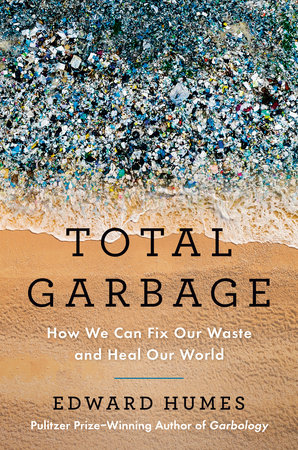
 Total Garbage by Edward Humes

You can read more about this and other efforts in the Pultizer Prize winning author Edward Hume's new book, Total Garbage: How We Can Fix Our Waste and Heal Our World.

Just in the past 24 hours I've learned about  two distinctive approaches to building a sustainable future that seem worth delving into. In both tone and depth they appear to be particularly useful for our time. The invoke the spirit of cooperation. Maybe one or both of them will fuel something useful to you.

Rock Creek Institute https://rockcreekinstitute.org/

Berggreun Institute  https://berggruen.org/


Monday, November 20, 2023

Trying to Make Sense of it All


Today in my daily ritual that begins with a cup of coffee accompanied by the opening of a book, I was challenged by which one to open first. Morning time is nonfiction time for me. I ultimately decided on the newest book that was sitting away from the current reading stack. Wasteland: The Secret World of Waste and the Urgent Search for a Cleaner Future by Oliver Franklin-Wallis. It caught my eye on the new book shelf at the library last week. As per usual once the title grabs me enough to look between the covers, I decided it was worth the trip home to see if the writing was compelling enough to hold my interest. After reading the introduction a couple of days ago I decided it was.

Why that book this morning? I’m not sure. I know there was a thought that tonight I chair our recycling organization’s monthly board meeting and that maybe something I might read in it today could spark something in our meeting. But then, I’m also facilitating a different meeting later this morning with a statewide peace network, so why didn’t I pick up either Samantha Powers’ A Problem from Hell: America in the Age of Genocide or Cynthia Enloe’s Twelve Feminist Lessons of War from my pile?

I suspect, especially with the Powers book, that I can only handle small doses of the pain of stories of genocide from the past, as we are confronted with others who are experiencing this suffering as I write this. Too often, if not supported by my own government, we are complicit in that suffering. Having only read the introduction to Enloe’s book I don’t have enough of a sense to see exactly where it will take me.

The other two titles at hand, (there is still one up in the bedroom pile - Jill Lepore’s These Truths: A History of the United States, a birthday gift from Ellen) are Robin Wall-Kimmerer’s Gathering Moss: A Natural and Cultural History of Mosses and Marjorie Kelly’s Wealth Supremacy: How the Extractive Economy and the Biased Rules of Capitalism Drive Today’s Crises. Gathering Moss is a book I bought for Ellen when it first came out, for she is my naturalist connection. She pulled it out the other day and secretly added it to my pile and I at once began to savor it, as I did Kimmerer’s indelible Braiding Sweetgrass. I read a short chapter each morning and it is like a soothing meditation so rich in the heart, soul, and science of this neglected life form, for which I have some unknown affinity for.

Wealth Supremacy was a recent gift from friends who thought I would enjoy this exploration of the financialization of our society. They are right. Her take so far is a fresh consideration of the demise of our cultural drivers, especially during my lifetime. After consuming a chapter in Wasteland, I picked up Wealth Supremacy and read a chapter that focused on the importance of the use of language in shaping how we think about and value things - “When language is biased …when it casts worker income as “expense” and capital income as “profit”—we enter a symbolic order that denigrates us, marginalizes us or others, and disparages what we wish to honor”. (p.29)

But as I finished that section, I began to wonder how do all these different books connect? How could I weave both my journey to accumulate and actually read them, and how on earth could I possibly describe their collective impact on how I think or live as a result of my encounter with them? I certainly seem driven to understand the intersection of many forces at work in our world. Perhaps it’s why I struggled as an undergraduate, changing my major every term from electrical engineering to journalism to psychology to sociology to political science to philosophy only to take a hiatus for a few years before returning to college. I finally connected and found a home in the field of geography that by design looks at many intersections of the human world with the natural one. It was through that discipline and those teachers that I became aware of aware of the importance of the living world and our interactions with it. I remember two significant papers I wrote back in 1974 – one on the El Nino effect  for a climatology course (it was a pretty new theory at the time) and the second, a proposal for establishing recycling program for the city of Detroit. Funny, how 50 years later those issues are much more visible.

The emerging field of sustainability builds on that awakening that geography provided for me. And the field continues to go deeper and broader in understanding all those many intersections. When I worked on the two volume encyclopedia Achieving Sustainability: Visions, Principles and Practices (2014) I was tasked with explaining these intersections. With the help of my gifted design colleague, Theresa Moore, I came up with this image

The concept tries to show that the economy is a wholly-owned subsidiary of the society which is a wholly owned subsidiary of the environment. The image also tries to convey these intersections are not static, but dynamic. As I glance at this now, I wonder if the UN Sustainable Development Goals had been agreed to then, if I might have substituted those 17 goals for the individual ones I listed, since most of them correspond to those goals.

Obviously, this is a an incredibly complex system to understand, especially since it is not static. We shape the systems in what we do, how we engage with each other and with the natural world. Wealth supremacy is the headline in the Washington Post and The Guardian this morning with the release of a new Oxfam report noting the incredible supremacy of the wealthiest impact on our climate – “TOP 1% Responsible  for More Carbon Emissions Than the Bottom 66%”.

“To take what we need to support our profligate lives, and leave a ransacked and destabilized world for our grandchildren, is not worthy of us as moral beings.”

(Kathleen Dean Moore, Great Tide Rising: Toward Clarity and Moral Courage in a time of Climate Change. Berkeley: Counterpoint, 2016. p.4)

I read to try and better understand how we might learn to live together sustainably and in peace. The Oxfam report is more evidence that the current approach is leading us towards an abyss. Our journey towards sustainability continues. It’s the least I can do with the time I have left. Keeping ideas of better possibilities alive in hopes, as Milton Friedman once said:

“Only a crisis - actual or perceived - produces real change. When that crisis occurs, the actions that are taken depend on the ideas that are lying around. That, I believe, is our basic function: to develop alternatives to existing policies, to keep them alive and available until the politically impossible becomes the politically inevitable.”