Tuesday, February 7, 2017

Do We Really Want to Build and Defend an Empire?

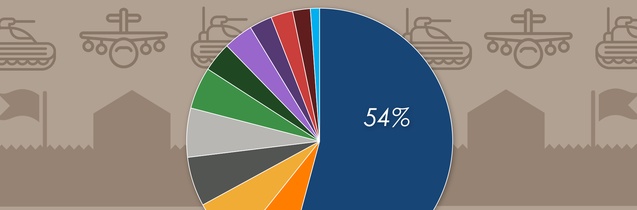
As veteran defense analyst William Hartung notes yesterday, the new Trump administration is poised to put an already immense defense budget on steroids. He's obviously thinks the condition of our military is deplorable and thus there will be endless flows of additional cash recommended, except perhaps for the boondoggle known as the F-35.

But while Trump is poised to offer a significant injection, all presidents since FDR and the end of WWII have been building our military apparatus in one way or another. As the former general turned Commander-in-Chief, Dwight Eisenhower so vividly warned us upon exiting the office he held for two terms, the behemoth engine of the military-industrial-complex(MIC), will drive us away from repairing and improving our own society.

     Every gun that is made, every warship launched, every rocket fired signifies, in the final sense, a theft from those who hunger and are not fed, those who are cold and are not clothed. The cost of one modern day bomber is the modern brick school in more than 30 cities. It is two electric power plants, each serving a town of 60,000 population. It is two fine, fully equipped hospitals.

And so it has unraveled as Eisenhower warned. Nary a president has escaped its clutches. Even the Nobel Peace President Obama, was arguing for a $1 Trillion dollar modernization effort of our nuclear weapons system, while launching a record number of drone attacks in countries all over the globe. The problems with military spending are so significant and embedded, that hardly anyone in elected office is willing to publicly take them on. The Washington Post reported just last November that the Pentagon's on internal study found $125 BILLION was wasted. And of course, they tried to hide the report. But even since its release, there has been a deafening silence from the Washington beltway, as the lobbyists from McDonnell-Douglas, Lockheed Martin,Boeing, and other (too big to fail) behemoths spread their loot and influence in the halls of Congress.

Then of course there is the revolving door between the Pentagon and the MIC, where former officers move with their significant pensions, to rewards aplenty from the scions of military hardware. Those scions have strategically scattered their plants and contractors around the country to insure that any cuts in government contracts can bring the many impacted congressional districts elected representatives to rise up to thwart them. Thus the long failed history of the  F-35.


Image result for washington rules bacevich

Insulating this cozy brotherhood from any rational questions has been the role of  fear-mongers and empire builders who have argued as former West Point graduate, Lieutenant-Colonel and Professor of International Relations Andrew Bacevich  has written about extensively. In his 2010 book, Washington Rules: America's Path to Permanent War, Bacevich lays out the U.S. sacred trinity of  military policy and practice.

     an abiding conviction that the minimum essentials of international peace and order require the United States to maintain a global military presence, to configure its forces for global power projection, and to counter existing or anticipated threats by relying on a policy of global interventionism." [page 14, emphasis in original].

Bacevich is one of the few scholars willing to stand up to the MIC. Some others have joined him and are sharing their writing through the  American Empire Project, The late Chalmers Johnson, Jonathan Schell  and Howard Zinn as well as contemporaries Noam Chomsky, Tom Englehardt, Nick Turse, Michael Klare and a few more fearless scholars and journalists.

Image result for american empire project

Fortunately we have a few think tanks that collect and scour the available data and help us make sense of it. As the Pentagon waste study mentioned above hints, the Pentagon is the only department in the government has not had an audit performed. Legislation to require such and audit has been introduced in past years, but even the good old deficit hawks aren't interested is looking at the underbelly of defense pork.

Image result for national priorities project
Nationally we have the National Priorities Project which continues to collect and to prepare useful charts and studies that give us a clue of how the splurging for military impacts us. Particularly useful is data on the impacts at the state level of that spending.


The Project on Government Oversight also hosts the Center for Defense Information where you can read much more on the troubled F-35 or numerous other serious investigations into the MIC.Image result for project on government oversight

Globally we have the highly regarded SIPRI (Stockholm International Peace Research Institute) that annually gathers global data on militarism, arms sales, and other related information allowing some measure of comparison among nation states.

Home


Former cold warrior, turned critic of American empire, the late Chalmers Johnson wrote a series of acclaimed and powerful books beginning with Blowback: The Costs and Consequences of American Empire (2000) in which he documents the control of the MIC over our foreign and domestic policy and the resulting consequences of that policy and practice. In his final book published shortly before his death in 2010 Johnson summarizes the argument.

       Once upon a time, you could trace the spread of imperialism by counting up colonies. America's version of the colony is the military base. By following the changing politics of global basing, one can learn much about our ever larger imperial stance and the militarism that grows with it. Militarism and imperialism are Siamese twins joined at the hip. Each thrives off the other. Already highly advanced in our country, they are both on the verge of a quantum leap that will almost surely stretch our military beyond its capabilities, bringing fiscal insolvency and very possibly doing mortal damage to our republican institutions. (Dismantling the Empire: America's Last Best Hope).p.114

Johnson goes on in depth to show how this pursuit of empire, this ailment of American exceptionalism, not only robs from our own development and well-being, but sows the resentment that all imperial attempts to control other nations feeds. In a word, blowback. His concerns even before his untimely death were that the horrible events of September 11, 2001 were symptomatic of what will follow any nation that is hooked on militarism.


With the arrival and now solid ownership of the executive branch of government by the combination of the military mindset and the Goldman Sachs greed merchants, there is ample evidence to support the decision January 26th by the Bulletin of Atomic Scientists to move the Doomsday Clock two and a half minutes to midnight. We better heed the calls of Johnson, Bacevich, and others who have seen war and its consequences and question our unfettered support for militarism over human well-being. It's not too late, but it's close.

Sunday, February 5, 2017

Taxes Are the Dues We Pay to Live in a Civilized, Democratic Society

[I attempted to get this viewpoint published in three newspapers in Michigan without success. So I am putting it out there via the blogosphere. Share as you see fit].


Taxes are the dues we pay to live in a civilized, democratic society.

Recent Michigan legislation introduced to eliminate the state income tax therefore suggests the end of our so-called democracy.  We have been accelerating our race towards oligarchy in recent years with the deleterious Citizen’s United case that makes it easier for the wealthy to purchase elections, the recent election handing the 0.1% the reins of government, and the avalanche of mergers and acquisitions that concentrate more wealth and power in fewer and fewer hands.

Who accrues the most from the elimination of income tax? No surprise, it’s the wealthiest among us. And when government is totally starved, who will repair all the market failures and pay for externalities like pollution that aren’t in the private sector’s balance sheets? The extreme wealthy already own our government via fossil fuels, banking, the military-industrial-complex and pharmaceutical conglomerates, with their minions at the top. A functioning democracy would wrestle some of the power back to the citizens. Voting isn’t enough. Citizens need to pressure government to do the right thing.  Democracy is not a spectator sport.

Here’s an example: The poisoning of the Tittibiwassee River from dioxins was largely the work of Dow Chemical upstream in Midland. Once the problem was identified, largely with the help of concerned citizens who live in the watershed, Dow was approached by the DEQ and EPA to fix it. But Dow, now merging with Dupont after swallowing Union Carbide following that firm’s deadly example of citizenship in Bhopal, India, sought delay after delay. The cost of cleanup was substantial, hence their reluctance to finance the repair, a similar story only magnified in Bhopal .  But much of the Dow largess is tucked away in Dow Family foundations, which bequeath some small portion each year to beautify Midland and support other community causes; the benefactors are then showered with adulation from those who benefit from the crumbs from their table.'

When I sat for a brief stint on an environmental advisory panel that looked at that issue more than a decade ago, I noted that tapping some of the Dow Foundation money could easily cover the cost of cleaning up the Tittibiwassee mess. Of course, such a radical suggestion was quickly ignored and the foundations, who weren’t at the table, weren’t offering.

There is something magical about great wealth. We tend to be enamored of it, perhaps imagining ourselves living in palatial surroundings, totally unconcerned about expenditures. Those who argue that the wealthiest among us pay the most in taxes (in real dollars) always neglect a fundamental reality: it’s not how much one pays but how much one has left that really matters.

The median household income in the US is roughly $50,000.  Current Michigan tax (4.25%) on that amount is $2,125, leaving $47,875. To be in the semi-lofty 1% category you need to make a minimum of $429,000, in which case your tax would be $19,072, leaving you a meager $409,928 to scrape by. But this is one year only. If those incomes stay steady for even ten years the one-percenters earn $4,290,000 and pay democracy dues of $190,725, leaving them with $4,099,275 compared with our median family which has earned $478,750. The difference, then, between the two families’ wealth has grown from $362,053 to $3,620,500.


Logo

This is the disease that is spreading rapidly here and abroad. It is now among the highest risk concerns as identified by the World Economic Forum in their recent 2017 Global Risks Report. Our state legislators are oblivious. We shouldn’t be.


Wednesday, January 18, 2017

Two Recent Major Reports of Note

Here are two reports issued in the past ten days from two very different sources that should get way more play than they are receiving. There is a confluence between the two that I shouldn't have to explain once you look at them. One report comes from the international development and relief agency Oxfam, which notes that

Image result for oxfam 8 richest

Oxfam’s report, ‘An economy for the 99 percent’, shows that the gap between rich and poor is far greater than had been feared. It details how big business and the super-rich are fueling the inequality crisis by dodging taxes, driving down wages and using their power to influence politics. It calls for a fundamental change in the way we manage our economies so that they work for all people, and not just a fortunate few.[Oxfam press release].

Six of the eight men are from the U.S.

  • Bill Gates (US)
  • Michael Bloomburg (US)
  • Carlos Slim Helu(Mexico)
  • Jeff Bezos (US)
  • Mark Zuckerberg (US)
  • Larry Ellison (US)
  • Warren Buffet (US)
  • Amanzio Ortega Gaona (Spain)
The richest are accumulating wealth at such an astonishing rate that the world could see its first trillionaire in just 25 years.  To put this figure in perspective – you would need to spend $1 million every day for 2738 years to spend $1 trillion, the report noted.

But maybe you aren't concerned about this escalating inequality. Well then, if Oxfam is maybe just a little too liberal of a source for you, check out the World Economic Forum's recently released Global Risks Report 2017. The WEF is the bastion of the world's elite politicians, corporate leaders, and a sprinkling of other big players that meet annually in Davos, Switzerland. They are meeting as I write this.

Logo  


This annual assessment based upon a survey of some 700+ leaders offers a glimpse at what we might see unravel in the near future.

Global Risks Trends interconnections


If the elites are concerned enough about the intersections of these global challenges, perhaps we should nudge our elected leaders to enact policies to address them, not to make them worse.
  

Sunday, January 15, 2017

Hope, Lies and Making Change

I was up early as usual yesterday morning to sneak in a little quiet reading time before heading off to set up for our local monthly recycling drive we've been operating for 28 years. It was chilly (14 degrees) and dark when I loaded up our 1999 Ford Ranger, 4-cylinder truck with our material before swinging by the elementary school to load some of their recycled paper, tin and plastic to our drive site. 


This monthly adventure allows me to catch the national NPR show, On the Media, which is unfortunately the only time I ever hear it. Bob Garfield and Brooke Gladstone have been doing this always thoughtful and reflective show for many years.


Since the truck was not yet warmed up I had the heater fan off, which made listening to it easier. Before I got to the school they aired a segment that inspired this blog post. Bob Garfield was demonstrably depressed by the state of our politics and the press and he was trying to cope with it. Wherein a colleague referred him to a book by Rebecca Solnit, Hope in the Dark. [Those of you who may been occasional readers of this blog will note that name, and even that book, from which I have added one of my favorite quote, which I'll add at the end. Here's another blog post that excerpts a quote from a 2013 essay or this one from a post-2016 election essay.]

Image result for rebecca solnit

But Garfield went further than just trying to summarize the book. The colleague suggested he contact Solnit to see what she had to say and therein lies the reason for this blog. I have never heard Rebecca Solnit. I knew that she was one of my favorite writers - penetrating, lyrical, powerful and unafraid to stare into dark corners of our world. But Solnit is not simply a writer. She is also an activist and it is from that personal engagement that the fire and power of her writing emerges. I was somewhat anxious that she would not be as powerful a speaker, especially in an interview environment. Some people we know write beautifully, but speaking live on the spur of the moment doesn't allow for the editing that good writing does.

Not to worry, despite a very different voice than I expected, the exchange with Garfield, by both of them was uplifting in ways I cannot give adequate words to. The 11-minute audio track from the show is a necessary vaccination for all progressives as we enter the dark times. Please take the time to listen to this segment. I also suggest those of you who have access to On the Media through your local NPR station, add it to your regular diet of listening.

Below is a quote I have used in many talks and in many things I have written. If by the time you get this far in the blog you have not listened to the interview with Garfield, perhaps reading this tiny excerpt from the same book that inspired Bob Garfield to call her for an interview, this might nudge you to do so. I believe you will be glad you did.

     Causes and effects assume history marches forward, but history is not an army.         It is a crab scuttling sideways, a drip of soft water wearing away a stone, an                 earthquake breaking centuries of tension. Sometimes one person inspires a                 movement, or her words do decades later; sometimes a few passionate people             change the world; sometimes they start a movement and millions do; sometimes         those millions are stirred by the same outrage or the same ideal and change                 comes upon us like a change of weather. All of these transformations have in               common is that they begin in the imagination, in hope. To hope is to gamble. It’s         to bet on the future, on your desires, on the possibility that an open heart and               uncertainty is better than gloom and safety. To hope is dangerous, and yet it is             the opposite of fear, for to live is to risk.

I say all this to you because hope is not like a lottery ticket you can sit on the sofa and clutch, feeling lucky. I say this because hope is an ax you break down doors with in an emergency; because hope should shove you out the door, because it will take everything you have to steer the future away from endless war, from the annihilation of the earth’s treasures and the grinding down of the poor and marginal. Hope just means another world might be possible, not promised, not guaranteed. Hope calls for action; action is impossible without hope. At the beginning of his massive 1930s treatise on hope, the German philosopher Ernst Bloch wrote, “The work of this emotion requires people who throw themselves actively into what is becoming, to which they themselves belong.” To hope is to give yourself to the future, and that commitment to the future makes the present inhabitable. 

             -Rebecca Solnit, Hope in the Dark,


If you need an extra boost here's a link to Stand Up (and Be Strong) by Keb Mo 

Wednesday, January 4, 2017

Thoughts at Large at the Beginning of the Year

I heard a clip on the radio today of VP-elect Pence stating that the November election  showed the overwhelming vote of the American people was to get rid of the Affordable Care Act. Well of course this is an outright lie on two counts. Even if everyone who voted for Trump was against the Affordable Care Act, highly unlikely and impossible to prove, Mr.'s Trump and Pence actually had more voters vote against them than for them.!!! They received only 48% of the vote which means 52% of the people wanted someone else. The Republicans lost six seats in the House, even though they have a commanding lead in the number of seats (241 to 194)  or 55% of the seats. Total votes for the House the Republicans received 1.1% more votes than the Democrats, but still less than 50% of those cast for US House seats. If ever the use of the term "mandate" was inappropriate this is clearly one. Make sure when it is used you call them out. (Ballotpedia LogoSee Ballotpedia for the data).

*********

On this evening's broadcast of  Martketplace there was story about Secretary of State nominee Rex Tillerson's plan to divest his holdings in Exxon Mobil. I believe I heard some interviewee suggesting that this would be quite a loss for him. When he could cash out for $55 million in present stock and an addition $182 million in deferred stock are we supposed to feel sorry for this guy. 

If the HOUSEHOLD (not individual) median income (50% of households earn more and 50% less) is approximately $50,000 and the typical working lifetime is about 50 years, that means a lifetime of median income would have a household collect about $2.5 million. Tillerson's stock value alone is 100 times that amount and does not include his income received over the many years of his working life. How much is enough!!!!

Exxon Mobil's Rex Tillerson speaks at a discussion organized by the Economic Club of Washington.

*****

Has anyone who has been yipping at the diverse countries at the UN who signed UN Resolution 2334 regarding the Israel/Palestine conundrum actually read it???? You had countries as diverse as Malaysia, New Zealand, Spain, France China, Russia, Japan, Uruguay, Angola, Senegal, United Kingdom, Venezuela, and Egypt all voting in support? Why, because they are all anti-Semites??? That's what you would think if you listened to the critics both in Israel and among our own Congress. As you will read in the resolution and as you can better understand if you are willing to listen/watch Secretary of State Kerry's thoughtful and powerful explanation of the US abstention, we can either have international law and agreements which we honor or we throw them all away and go back to all out war, every country for itself.

Image result for john kerry speech c span israel

*****

Hardly a peep about climate change in the political discussion save the notation of all the climate deniers the President-elect hopes to surround himself with in his new cabinet. Even as the the climate science community gets ready to officially declare 2016 as the hottest year on record following  the pattern you see below.


Image result for climate change warmest years

Having just finished David Orr's recently released superb Dangerous Years: Climate Change, The Long Emergency, and the Way Forward (Yale University Press, 2016), I feel MLK, Jr's deep sense of the "fierce urgency of now". But as Orr does better than anyone else I've read or heard, you see the ties that bind and the durable threads essential for creating a fabric of life that is sustainable. He has long been higher education's sage of sustainability. As Dangerous Years makes vividly clear Orr has immersed himself in the literature of many disciplines - biology, physics, philosophy, economics, sociology, history, literature, the classics and of course political science. His writing is powerful and persuasive, but he is not arrogant as the following passage clearly notes. In it he is describing the two-and-a-half reasons we should have concerns for future generations. In this section he begins to describe his half reason.

         "My half reason to act on behalf of future generations follows. It is discounted by half because it rests entirely on the unverifiable grounds of my own feelings and experience such as they are. I cannot say for certain whether my life is a gift or not, but even with its ups and downs it certainly feels like one. I cannot say for certain that the feeling of sea winds in my face, or the fragrance of spring flowers, or the sounds of whitewater, or the comforting solitude of an old-growth hemlock forest, or the view from an Appalachian ridgetop, or the feel of good oak, or the hug of an old friend, or the smell of rain after a long hot drought or that of newly plowed ground, or the red-tail hawk that is nesting in my yard this spring, or the delight of fireflies on a summer evening are gifts. But they give me pleasure and they feel like beneficence beyond any thoughts I can muster. I cannot say with cool scientific logic why such things should be passed on unimpaired to my four grandchildren. But I fervently hope that they will be. I can only say that I am very thankful that others before us protected what they did or were unable to damage more than they did.

        Whether life and all that it entails, including pain and suffering, has come to each of us as a gift or by some random chance no longer interests me. How could I know such things? Either way I can imagine no good reason to destroy, cheapen, deface, or risk harm to the biotic community and the enterprise of life. I can, however , think of many reasons to protect life from the vast planetary cycling of water and materials down to the pair of cardinals nesting this spring in my side yard. I believe myself to be better off because they're busy raising their brood and that makes me happy. I am even willing to chase off the neighbor's cat prowling close by on their behalf. Exactly why I cannot say, nor do I think it very important to give reasons or analyze further. In all of our efforts to conjure up reasons for one thing or another down to parts per million, one thing is missing is the sense of wonder that exists beyond words and reasons. Theologian Abraham Heschel once said that 'a l;ife without wonder is not worth living.' In that spirit I am content to find my cardinals ad their brood wonderful and feel blessed by their presence in some mysterious, unnamable way and let It go at that. But I am distraught by the possibility that these wondrous things may go extinct, never to be experienced by my descendants and yours." (p. 134-5)


While Orr is simultaneously lyrical and scholarly, you can feel his heart and soul in this book, a culmination of a life's work, a crescendo of head and heart. His 50 pages of annotated notes are themselves an education from which he has plumb the depths of many to synthesize for us both a description of the challenges, and possibilities for solutions. He finishes with one example from his own current community level work which is a poster child for communities everywhere - the Oberlin Project

Sunday, December 11, 2016

Time to Break Silence


Well I haven’t exactly been silent in recent years, but I think the circumstances we are in call for being unafraid to stand up to forces that are dragging us toward our collective demise, but also to offer alternatives that redirect us towards a more just and peaceful future. It will be 50 years in April, when Martin Luther King, Jr. gave his most radical and courageous speech at Riverside Church in New York City. In fact, it occurred one year from the day of his murder in Memphis. That speech , where he came out against the Vietnam War, brought him all kinds of hate mail, even from within the civil rights movement from some who believed he was jeopardizing that work.

He chose that title inspired by a recent statement from Clergy and Laity Concerned, a group that was sponsoring his speech, which opened with, “A time comes when silence is betrayal.”

The truth of these words is beyond doubt, but the mission to which they call us is a most difficult one. Even when pressed by the demands of inner truth, men do not easily assume the task of opposing their government's policy, especially in time of war. Nor does the human spirit move without great difficulty against all the apathy of conformist thought within one's own bosom and in the surrounding world. Moreover, when the issues at hand seem as perplexing as they often do in the case of this dreadful conflict, we are always on the verge of being mesmerized by uncertainty; but we must move on.

And some of us who have already begun to break the silence of the night have found that the calling to speak is often a vocation of agony, but we must speak. We must speak with all the humility that is appropriate to our limited vision, but we must speak.

The increasing evidence of climate destabilization and its acceleration demands that we act, as King suggested then “with the fierce urgency of now.” We can’t ask that the necessary sacrifices be borne by those already struggling to survive or to find some basic level of security. Our situation has been manufactured in significant part by those who gorge at the consumptive trough.

The Trump regime appears to be handing power to those who have been gorging. Four billionaires so far for cabinet offices, most of the rest are multi-millionaires. We have apparently so idolized profit driven market over the past forty years, that even noted theologian Harvey Cox has equated it to God. The unrestrained drive for profit over everything has accelerated both climate change and growing income inequality both domestically and globally. And of course they are linked. If we want to address either of these urgent crises we must tackle runaway private profit.

Cover: The Market as God in HARDCOVER


We need to move towards more equal sharing of the gifts of this planet with a strong commitment to care for the life forms we share it with. We can do this. Herein are a series of possibilities. They aren’t the only ones , I’m sure, but I offer them in hopes of moving us towards solutions that will address the dual crises before us.


We need to peg maximum salaries to reasonable ratios of the median household income. That income,  which marks the point at which 50% of the population earns more and 50% earns less in the U.S.  is $51,939 for last reporting year (2014).  I believe it is totally reasonable that in 2016 median household income should provide a family adequate housing, access to health care and education, nutritious and ample food, affordable utilities and transportation. Remember that this is household income, not individual income.

Some possible policy examples might be as follows:

1)      For an organization to receive nonprofit status and the benefits it accrues from it, no employee of that organization should make more than three times the median household income.  That’s nearly $156,000 which should be more than sufficient for anyone working for an organization that is not designed  to reap ‘profit’, but rather is supposedly committed to some aspect(s) of the common good. This includes schools and churches.

2)      Government employees should not make more than two times the median household income.  A commitment to work on behalf of fellow citizens should also carry with it a status.

3)      Private sector employees should not make more than 10 times the median household income. This should apply for all for-profit enterprises and includes professional athletes, musicians, actors, etc.  The city of Portland just took a step in thisdirection, by passing a policy that companies that pay CEOs more the 100 times their lowest paid employee, will not be eligible for contracts with the city.

I offer the specific ratios not as fixed thresholds, but as starting place for the necessary conversations we need to have as a human family in the face of the pending crises. I would like to see the specific thresholds set democratically at least every five years.  As inequality is reduced in future years, these ratios should be reviewed. If the median household income stays at $50,000 that household would have an income of $250,000 over five years. Someone making ten times that amount would $2.5 million over the same period thus increasing their wealth difference from $450,000 to $2.5 million over that same time. In other words the disparity grows. The intent is to both curtail the increase in inequality, but also to be able to provide a better social safety net, while investing more in the prudent stewardship we need to enact to preserve the healthy functioning of our ecological services.

One could address this differently by applying a more progressive income tax like the one we had during our greatest growth from the 1940s and 50s. With the demise of the progressive income tax, reduced corporate taxes and the increase in exorbitant salaries for the 1 per cent we have not only drowned government services in the bathtub, we have shredded the social safety net and destroyed or severely damaged the ecological health necessary for us to thrive. With the election of Mr.Trump and his wealthy coterie of greedy advisers and cabinet nominees we are now at the “fierce urgency of now.” If these possibilities don't work, we need to come up with some that do, and in a hurry.


Thursday, December 1, 2016

The Time for Expanded Fellowship

I read this passage the other morning. It's from a book I wasn't looking for when we were browsing through its many floors of used books at one of the great used bookstores in the world, John K. King's in Detroit.

 Image result for king books in detroit

     "Without some notion of brotherhood, civilization, indeed the very life of the race, would have been impossible. But, through the ages, the idea of brotherhood has generally been restricted to members of the same family, tribe, nation or race, or believers in the same religious or political creed. There will always be a particular sense of fellowship resting upon common loyalties. But today the peace, and certainly the happiness, of the world requires a larger and more inclusive sense of brotherhood for all the sons and daughters of earth...This brotherhood must take account of the existence of important differences of opinion. Its emphasis must not lie on imposed unity of thought, but on a common abhorrence of cruelty, oppression, and everything that would reduce human life to the status of a commodity and man himself to the level of a thing."


Image result for norman thomas

Norman Thomas, letter to Everett R. Clinchy (1950) quoted in W.A. Swanberg, Norman Thomas: The Last Idealist. New York, Charles Scribner's Sons 1976, p. 331.

One of the reasons I believe it struck me enough to mark the page so I could go back and copy the quote, was that I have been reading more and more about efforts to end war, to create some vibrant form of global governance, and also reforming the United Nations. The issues we face, especially on a single finite planet that is both increasing in human numbers but even more so human impacts, requires us for survival to work together. To find in Thomas's words from more than 60 years ago "a larger and more inclusive sense of brotherhood for all the sons and daughters of earth."

I find it hard to imagine given those increasing challenges that only one year ago all 193 nations of the United Nations agreed on a need and commitment to reduce greenhouse gases for the betterment of all. And yet one year later, we have an election where the purported winner and his nominees are collectively hoping to unravel that essential foundation for a less troubling future. Mr. Trump's erratic hyper-individualism that he hopes to impose on our nation, if not the world, is truly in this writer's mind the most troubling of the results.

If it was simply himself, and we could hope that the democracy once created could work to constrain his excesses, perhaps we might survive his worse inclinations. But so far, I am seeing very little from the governance sector, save a few lonely Democrats, joined by sincere libertarians like Sen. Rand Paul, who dare confront this demagogue. This fear of confrontation, of standing up for what one believes, especially permeates the Republican Party with unfortunately rare exception, even at local government levels.

If we believe that Thomas had it right, and I certainly do, it is up to us to stand up for building and strengthening that sense of global brotherhood and sisterhood. The initial nominees of the president-elect are of course not only from the well-connected club of wealthy insiders, so much for "cleaning the swamp", but they are of a view that governance is bad, unless of course it profits a business they support. The reports of conversations that the president-elect has had with other national leaders shows he is still seeking advantage for his business ties, either directly his own, or for his 'friends'.

I am not optimistic about the next four years, but there is so much that we cannot predict, although we're pretty certain climate as we have known it for thousands of years will continue to destabilize. Perhaps one of our finest writers and thinkers Rebecca Solnit says it best.

“When big changes and dangers arise, you have to think big. You don’t put out a forest fire with a glass of water. Thinking small can prevent you from even recognizing trouble, let alone your options for overcoming it. There’s never been a time when thinking big matters more than now. Many across the United States are now trying to figure out how to survive Trump, but it may still be possible to stop him. His regime is not yet inevitable.

It’s a long shot, but one worth trying, the way someone diagnosed with a disease with a 3% survival rate might want to do what it takes to try to be part of the 3%. You don’t get there if you give up at the outset. Trump represents a catastrophe on a scale many seem to have trouble grasping, an attack on what remains democratic and uncorrupted in our old and messy system of government, a threat to international stability, to efforts to address climate change, and to human rights at home and around the world.”

 …read the whole piece here: