Showing posts with label income inequality. Show all posts

Tuesday, April 2, 2019

Enough Already!!


This was originally published at The Sports Column.


‘Enough Already!’ With Big Sports Salaries

The elephant in the room is increasing income inequality—the outlandish incomes and escalating growth at the top of the income chain. Perhaps nowhere is that situation more evident than in athletics.


Last month we saw two record-breaking salaries. The Phillies’ Bryce Harper signed for $330,000,000. Mike Trout of the Angels signed for $430 million.

While it would be easy to focus attention only on the highflyers of professional sports, that’s far from the only place where we have a problem. In college sports, the coaches—not the players—are raking in an outrageous amount of cash.

For example, Duke’s Mike Krzyzewski makes $8.9 million a year, and twenty-six other coaches make at least $2.5 million annually. That includes the 2019 Final Four coaches: Tom Izzo (Michigan State), $4.36 million; Chris Beard (Texas Tech), $3.17 million; Bruce Pearl (Auburn), $2.57 million; and Tony Bennett (Virginia), $2.43 million.

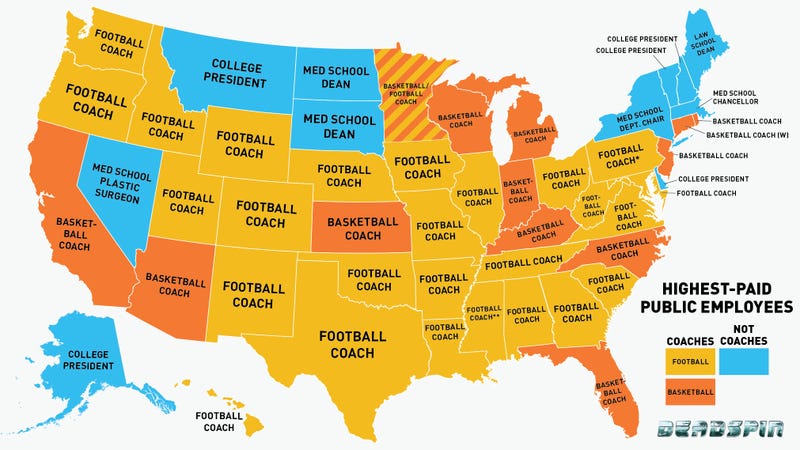
What makes the data especially problematic is that all of the Final Four coaches work at public universities. Worse yet, those huge salaries fit a larger narrative nationally: college coaches dominate the list of the highest income earners among public employees across the country.


How might we interpret those data through a broader lens? Let’s compare coaches’ salaries to the annual salaries earned by other public officials.

President of the United States: $400,000
U.S. Supreme Court Justice: $255,000
U.S. Senator: $174,000
U.S. House Representative: $174,000.
And what about high-ranking officials in the states represented in this year’s Final Four?
Virginia Governor: $175,000
Michigan Governor: $159,000
Texas Governor: $150,000
Alabama Governor: $119,950

In Michigan, the state’s governor would have to stay in office for nearly 28 years to match one year of Izzo’s salary. Alabama’s senior Senator Richard Shelby would need to serve 15 years to match Pearl’s annual paycheck.

The median U.S. household income is $61,372 per year. That means it would take about 40 years for an American household to earn what a high-end major college basketball coach makes in one year.
I know that coaching others is a noble profession. Most coaches love what they do, and getting paid for what they love to do is a gift. But nobody needs to make more in one year from doing what they love than what a typical family makes in a lifetime.

That’s what makes this situation outrageous! It might be different if we didn’t have nearly 40 million of our neighbors living in poverty, but we do. And if such inequality exists in public institutions, where in the world is the toe-hold to bring about systemic change?

Here’s a place to start. University trustees—especially those at public institutions—need to reassess institutional priorities, including putting the public good ahead of shallow gains associated with winning games and seeking athletic championships.

There are far more important ways to invest public resources—things like investing in the liberal arts, enhancing the financial status of part-time faculty, and improving salaries for hourly laborers who toil in custodial, food service, and other support areas across our universities.

The list of constructive things to do is long. The current situation—in public good terms—is indefensible.

Sunday, April 8, 2018

Golden Parachutes and Income Inequality


This practice has irked me for decades. In higher education we see it more often reported in relationship to highly paid athletic coaches and athletic directors when they are fired. The rest of us stiffs can work 30 years or more and retire with maybe a watch or other symbol of appreciation. Not the high rollers. On top of extraordinary salaries year after year,  they walk away when they are finished with benefits the rest of us cannot fathom.

Image result for golden parachutes

Case in point is the Lansing State Journal story yesterday on the former Michigan State University president. It is a common practice for tenured full professors, not for the rest of us, to get an extra year of salary when they retire for basically doing anything they want, or not much at all. Now the janitors, food service workers and others who make somewhere  between  $30,000 - $40,000 or so  a year, might get  handshake when they leave after 30 years. The MSU president who made millions over the years  at MSU will make an additional $700,000 for her first retirement year and then some $562,000 year  thereafter.  The janitor/food worker would have to work 40 hrs a week for 14 to 18 years to see the kind of money the lame duck receives.

Image result for map of highest paid public employees

Of course, the president is not  the highest paid campus employee. That honor would go, like in most states, to one of our coaches.  Men’s basketball coach squeaks by on $4.2 million (2017). While head football coach  got a juicy raise this year (2018) of  $700,000, because $3.6 million wasn’t enough, putting the two at parity.  Lord only knows what golden parachutes they will exit with. MSU is a public institution, for which it is hard to justify how high these salaries go. Unless, of course you raise the feeble neoliberal argument that the market is the supreme ruler that trumps any other value worth consideration.

MSU doesn’t report its median salary – that point between which half of the employees make more and half make less, at least the last time I tried to find it. While there are many professors and administrators who make six figure salaries the vast majority of those are between $100,000 - $300,000. A relative handful rise above that level.

The median household income in Michigan is $52,492. That’s a household income, not a per capita income. According to a study from 2016 by the Michigan League for Public Policy, Michigan is the 11th worst state for income inequality, where the top 1% earn more than 22 times than the bottom 99%. If MSU’s lowest salary is approximately $30,000 then if that ratio (22) transfers to campus, the 1% would make more than $660,000. There are probably roughly 10,000 full-time employees at MSU. The  100 highest paid would be a rough equivalent of the 1%. Our highest paid coaches each make about 140 times the lowest paid employee. Of course golden parachutes are never calculated into the 1% income stream. They are hidden.

Growing income inequality is one of the biggest challenges facing the human family here and abroad. While raising the floor to ensure everyone can live a decent life for working 40 hours will help,  the unconstrained acceleration of wealth accumulation at the top needs to be halted if this gap is to reach some more morally defensible level. You would think a public institution would have that as a key goal and want to provide a model for its students to observe .  But if we continue to hire leaders who continue to imbibe the neoliberal kool-aid, we can be sure the accelerating inequality will grow. Perhaps the LSJ story can inspire a serious conversation about this most serious and growing problem.

Thursday, March 23, 2017

The Rush to Avoid Taxes

We now have less than 30 days to finish up our federal tax forms and get them to the IRS and state capitols. As I noted recently in this blog, "taxes are dues for living in a civilized society". So why do we all seek every advantage to reduce those taxes? We want deductions for our home (interest on mortgage, property taxes, etc.), for our charitable contributions, for state and local taxes paid, the list goes on.

There is an entire industry focused on how not to pay taxes - accountants, tax lawyers, tax preparation firms, all promising big savings if you know where to look and how to manage your affairs to minimize the dues we supposedly pay for a civilized community. Can we deduct our travel expenses for volunteer work, how about the tax credit for our solar installation, or the new energy efficiency changes made to the home?

Of course these are relatively small deductions that save many in the middle class a few hundred, or maybe even a couple thousand dollars in taxes per year. How can we actually minimize our overall tax rate we have to pay? Simple - by managing our funds so that more of our income arrives through capital gains than real work. Not surprisingly capital gains are almost entirely in the hands of the wealthiest. The wealthiest 1% make more than a third of their income from capital gains. The  New York Times reported that "estimates show that nearly 70 percent of all capital gains benefits go to the top 1 percent." 

While the plutocrats and their neighbors cash in at lower income tax rates than middle class citizens with larger deductions and the lower capital gains rate, it seems like nearly everyone is hooked on the notion that paying taxes is something you must avoid. And if you are wealthy enough, you can afford the services of the aforementioned tax consultants to help you do so.


Of course the corporate world, also run by the wealthiest among us, takes tax avoidance to a whole new level, whether it's from hiding income in offshore tax havens, or having their hired lobbyists create a specific tax loophole for them, in exchange of course for a nice little contribution to the legislators that are willing to fill their pockets. Oh yes, again let's not forget how they use their accumulations to take advantage of that low capital gains tax rate.


While I'll admit I don't own a PhD. in economics, looking at changes in the tax rates since World War II shows a striking parallel shift in income inequality. Every time we make yet another reduction in the taxes for the wealthiest, we increase the inequality. The trickle down "voodoo economics" plan boosted by Ronald Reagan never really trickled down. Surprise!!!


Mr. Trump's recent budget proposal accomplishes this not simply by cutting rates directly, which he is certainly aiming to do, but as a recent analysis, reported by the New York Times last week  of the TrumpCare proposal indicates, that $1 Trillion in tax cuts embedded in it will over a decade will find their way into the pockets of the richest Americans.

The House Republican Tax plan as reviewed by the Center for Budget and Policy Priorities shows visually how the tax code may be further loaded to the wealthiest.


So the reduction in progressive taxation that gained steam with Ronald Reagan's "Voodoo Economics" continues.  Or does it actually get worse? If one looks at the holes collectively engineered into the social safety net by the Trump budget proposal,  we can see more and more people falling through it. But in Speaker Ryan's world, "it's their choice". 

If we are to live in a civilized society, that doesn't let our brothers and sisters fall through our porous safety net, we need to all consider paying taxes as our dues. Making that system fairer, i.e., more progressive, is essential to that end. The security of each of us is entangled with the security of all of us. 

One planet, one human family, one common future.

Wednesday, January 18, 2017

Two Recent Major Reports of Note

Here are two reports issued in the past ten days from two very different sources that should get way more play than they are receiving. There is a confluence between the two that I shouldn't have to explain once you look at them. One report comes from the international development and relief agency Oxfam, which notes that

Image result for oxfam 8 richest

Oxfam’s report, ‘An economy for the 99 percent’, shows that the gap between rich and poor is far greater than had been feared. It details how big business and the super-rich are fueling the inequality crisis by dodging taxes, driving down wages and using their power to influence politics. It calls for a fundamental change in the way we manage our economies so that they work for all people, and not just a fortunate few.[Oxfam press release].

Six of the eight men are from the U.S.

  • Bill Gates (US)
  • Michael Bloomburg (US)
  • Carlos Slim Helu(Mexico)
  • Jeff Bezos (US)
  • Mark Zuckerberg (US)
  • Larry Ellison (US)
  • Warren Buffet (US)
  • Amanzio Ortega Gaona (Spain)
The richest are accumulating wealth at such an astonishing rate that the world could see its first trillionaire in just 25 years.  To put this figure in perspective – you would need to spend $1 million every day for 2738 years to spend $1 trillion, the report noted.

But maybe you aren't concerned about this escalating inequality. Well then, if Oxfam is maybe just a little too liberal of a source for you, check out the World Economic Forum's recently released Global Risks Report 2017. The WEF is the bastion of the world's elite politicians, corporate leaders, and a sprinkling of other big players that meet annually in Davos, Switzerland. They are meeting as I write this.

Logo  


This annual assessment based upon a survey of some 700+ leaders offers a glimpse at what we might see unravel in the near future.

Global Risks Trends interconnections


If the elites are concerned enough about the intersections of these global challenges, perhaps we should nudge our elected leaders to enact policies to address them, not to make them worse.
  

Sunday, December 11, 2016

Time to Break Silence


Well I haven’t exactly been silent in recent years, but I think the circumstances we are in call for being unafraid to stand up to forces that are dragging us toward our collective demise, but also to offer alternatives that redirect us towards a more just and peaceful future. It will be 50 years in April, when Martin Luther King, Jr. gave his most radical and courageous speech at Riverside Church in New York City. In fact, it occurred one year from the day of his murder in Memphis. That speech , where he came out against the Vietnam War, brought him all kinds of hate mail, even from within the civil rights movement from some who believed he was jeopardizing that work.

He chose that title inspired by a recent statement from Clergy and Laity Concerned, a group that was sponsoring his speech, which opened with, “A time comes when silence is betrayal.”

The truth of these words is beyond doubt, but the mission to which they call us is a most difficult one. Even when pressed by the demands of inner truth, men do not easily assume the task of opposing their government's policy, especially in time of war. Nor does the human spirit move without great difficulty against all the apathy of conformist thought within one's own bosom and in the surrounding world. Moreover, when the issues at hand seem as perplexing as they often do in the case of this dreadful conflict, we are always on the verge of being mesmerized by uncertainty; but we must move on.

And some of us who have already begun to break the silence of the night have found that the calling to speak is often a vocation of agony, but we must speak. We must speak with all the humility that is appropriate to our limited vision, but we must speak.

The increasing evidence of climate destabilization and its acceleration demands that we act, as King suggested then “with the fierce urgency of now.” We can’t ask that the necessary sacrifices be borne by those already struggling to survive or to find some basic level of security. Our situation has been manufactured in significant part by those who gorge at the consumptive trough.

The Trump regime appears to be handing power to those who have been gorging. Four billionaires so far for cabinet offices, most of the rest are multi-millionaires. We have apparently so idolized profit driven market over the past forty years, that even noted theologian Harvey Cox has equated it to God. The unrestrained drive for profit over everything has accelerated both climate change and growing income inequality both domestically and globally. And of course they are linked. If we want to address either of these urgent crises we must tackle runaway private profit.

Cover: The Market as God in HARDCOVER


We need to move towards more equal sharing of the gifts of this planet with a strong commitment to care for the life forms we share it with. We can do this. Herein are a series of possibilities. They aren’t the only ones , I’m sure, but I offer them in hopes of moving us towards solutions that will address the dual crises before us.


We need to peg maximum salaries to reasonable ratios of the median household income. That income,  which marks the point at which 50% of the population earns more and 50% earns less in the U.S.  is $51,939 for last reporting year (2014).  I believe it is totally reasonable that in 2016 median household income should provide a family adequate housing, access to health care and education, nutritious and ample food, affordable utilities and transportation. Remember that this is household income, not individual income.

Some possible policy examples might be as follows:

1)      For an organization to receive nonprofit status and the benefits it accrues from it, no employee of that organization should make more than three times the median household income.  That’s nearly $156,000 which should be more than sufficient for anyone working for an organization that is not designed  to reap ‘profit’, but rather is supposedly committed to some aspect(s) of the common good. This includes schools and churches.

2)      Government employees should not make more than two times the median household income.  A commitment to work on behalf of fellow citizens should also carry with it a status.

3)      Private sector employees should not make more than 10 times the median household income. This should apply for all for-profit enterprises and includes professional athletes, musicians, actors, etc.  The city of Portland just took a step in thisdirection, by passing a policy that companies that pay CEOs more the 100 times their lowest paid employee, will not be eligible for contracts with the city.

I offer the specific ratios not as fixed thresholds, but as starting place for the necessary conversations we need to have as a human family in the face of the pending crises. I would like to see the specific thresholds set democratically at least every five years.  As inequality is reduced in future years, these ratios should be reviewed. If the median household income stays at $50,000 that household would have an income of $250,000 over five years. Someone making ten times that amount would $2.5 million over the same period thus increasing their wealth difference from $450,000 to $2.5 million over that same time. In other words the disparity grows. The intent is to both curtail the increase in inequality, but also to be able to provide a better social safety net, while investing more in the prudent stewardship we need to enact to preserve the healthy functioning of our ecological services.

One could address this differently by applying a more progressive income tax like the one we had during our greatest growth from the 1940s and 50s. With the demise of the progressive income tax, reduced corporate taxes and the increase in exorbitant salaries for the 1 per cent we have not only drowned government services in the bathtub, we have shredded the social safety net and destroyed or severely damaged the ecological health necessary for us to thrive. With the election of Mr.Trump and his wealthy coterie of greedy advisers and cabinet nominees we are now at the “fierce urgency of now.” If these possibilities don't work, we need to come up with some that do, and in a hurry.


Sunday, November 13, 2016

One Possible Pathway at the Fork in the Road

Image result for fork in the road

We are two weeks away from the fourth anniversary of this blog. I had no idea I would continue to pass along some of the ideas that I continually bump into for this long. In fact, this post is number 227 over that span. I have no clue who reads what. Although I do get notes, or sometimes people I meet say they have read some piece or another. I suspect a few individuals read many. The website data tells me I average 150+ readers per post, but I know nothing about them or whether what they have read has propelled them to pick up one of the books or articles I reference in most posts.

Today, I want to try a little different track -- one more closely in line with the title of the blog, Possibilitator. While I hope all my posts offer some possibility of viewing or understanding our world a little better, this one is aimed more specifically to directions and actions we might consider as we seek to re-balance our lives from the outcome of this week's election results.

I have no intention of reanalyzing why the election resulted the way it did. I like to believe that I would have written this same piece regardless of the outcome. Although, the specific outcome has been a spur to move ahead with ideas that have been invading my head for awhile. For regardless of who sits it which seats of government, my responsibility is to push for justice and peace and speak the truth as I know it. That last sentence should paint clearly a picture of my own fallibility in knowing completely this world we share. Acknowledging from the outset the incompleteness of my understanding can allow me to learn. Where I can't acknowledge that imperfection, I will not be able to learn.

So the following is offered with that humility, but with assertions that I will try to support by noting their origins.

1)     The planet we share is increasingly destabilizing from that which has allowed us to emerge as a species. We know this not only from the rigorous scientific work and consensus process of the International Panel on Climate Change, but from the similarly rigorous work of the 2003 UN Millennium Ecosystem Assessment. Subsequent reports tend show that the ecological unraveling is accelerating faster than most scientists projected.

2)     Income inequality, both nationally and internationally is also at it's highest level in a hundred years. We know this from reports from our own census data and data from countries around the planet. Research also shows that with growing income inequality we tend to see higher levels of societal ills, including increasing child mortality, more crime, more violence, more poverty, less life expectancy.

3)     Political power is concentrating more and more in the hands of the wealthy few. There are numerous serious studies that indicate this fact, as noted by three highly regarded political scientists in comprehensive research on the topic.

4)     Women and people of color, as our own nation's history demonstrates, have not had equal opportunity. While progress has been made, we are a long way from a society where discrimination by gender and race is an anachronism.

These issues confronted us before the election last Tuesday, and they confront us today. It would be a foolish mistake to assume that those elected to govern this week have all the answers to these complex challenges. No one does. If we are concerned with any or all of these challenges it becomes our responsibility to learn more and to advocate for changes we believe. These suggested changes should be based on whatever evidence we can unearth, to effectively address these challenges.

We are constrained in many ways. Principally we are constrained by the fact that there are no quick solutions that we are certain will work. Even if we are wise enough to select and apply the options that lead to reducing the threats of these challenges, we likely won't know that from one two-year Congressional term or one six year Senate term. Note how long it took us to end slavery or for women to get the vote? These challenges will take dedicated effort for generations. Yet our culture looks for quick fixes - the corporate quarterly report, the daily stock price, or monthly unemployment or housing figures. As we speed our lives up we have moved from hand written letters to telephone calls, to emails, to now 140 word character messages, the preferred medium of our new president. Such a constricted environment can have no room for nuance or complexity, let alone the interdependence of multiple systems.

So how might we move forward under these circumstances?

I offer the recently globally agreed upon Sustainable Development Goals. These 17 goals cover all of the challenges I mentioned above plus a few more. 193 nations of the world agreed on these goals a year ago. The United States agreed to these goals. These goals have actual measures that have been produced and for each nation state to be measured against. They have a deadline, 2030. The agreed upon penalty is that our planet will be in even worse shape in 2030 if we don't meet these goals together.

As an individual those seventeen goals might seem beyond our ability to effect them. Different individuals looking over the goals will be drawn more strongly towards some than others, based largely on one's own circumstances. It is indeed hard to focus on all of them at the same time, but that is a weak excuse for doing nothing. For those reading this far and who are struggling on how to engage with the world under the new regime, I suggest you look over those goals and find one or two that call to you most deeply. Find organizations, government agencies, businesses that are concentrating on them and get involved. Speak up, write letters, suggest policies, volunteer. See how the issue dovetails with the other 16 goals. Does your work assist accomplishing other goals, or does it hinder?

Let's have companies and nonprofits provide annual reviews of their own operations and how they contribute to or hinder accomplishment of the 17 goals. There is already a few scorecards that approximate an SDG scorecard. B-Corporations have a certification process that covers most of the goals. More recently, Austrian economist, Christian Felber has developed a Common Good Balance Sheet that addresses many of the same challenges. These scorecards could assist consumers and other businesses and organizations when choosing which entities to support. There could be provided, as Felber suggests, incentives for those companies and organizations which receive higher scores for the common good - preferred purchasing contracts from governments, reduced loan interest rates, quicker review of regulatory requirements, etc..


No doubt in the weeks and months ahead, there will be plenty of need to use our citizen voices and power to halt actions we deem harmful to our brothers and sisters and our planetary health. But we need also voices committed to providing positive alternatives. This election shows the harm caused when so many voters voted more against one candidate than for another. We need candidates and others to help provide us with new ideas, based on best evidence we can muster, to try and meet the goals that the human family through our global governance system have agreed to. Such a pursuit should not be about winning, but about bringing our collective intelligence together to devise policies better than any single-party could devise alone.

We're all in this together, and until we get the majority of people realizing this fundamental truth and working together, those goals for 2030 and our ability to thrive beyond that are in jeopardy.

Richard Falk, noted international relations scholar, offers a powerful serum for needed citizenship in Citizens v. Subjects in a Democratic Society.


      The moral substance at the core of genuine citizenship only exists if the political structure        allows opposition without imposing a severe punishment. If citizenship is possible, then it automatically gives rise to responsibility to act accordingly, that is, by honoring the imperatives of conscience. Unfortunately, considerations of prudence, career, and social propriety make it more attractive these days for most Americans to behave as subjects living within a rigid set of constraints. Citizens are those who not only proclaim the virtues of freedom, but act responsively to the vectors of conscience even if these go against the established public order and prevailing cultural norms.