Showing posts with label community. Show all posts

Tuesday, October 22, 2019

Beginnings and Endings


As I approach the conclusion of seven years of blogging under the moniker of Possibilitator, it is clear that my production has dropped precipitously. It has been clear since early this year that my ability to read and write at the earlier level is diminished. So as I looked back recently at some of those posts I was surprised at the numbers. If I actually publish this one it would be the 269th blog over that time, but only the 4th this year. The blogs have been viewed nearly 100,000 times by lord only knows whom, maybe Russian bots.


Possibilitator


It was interesting to read the initial post that gave the blog its name – Possibilitator. In reading it this past week I can still say I am happy with what I proposed to do seven years ago. I was not dogmatic in always following the ideal expressed in that post, but largely I did. The hope has been to share some ideas of others that I encounter along the way that resonated with me at the time, and that I judged were of high enough quality to suggest they might be worth your time. Almost nothing I have referred to in this blog have been best sellers, or voices you might hear on broadcast tv, or read in local or national newspapers.   

What it shows me is that all over the world, there are many people thinking and acting to more clearly understand the world we share and to try to make it better, not just for themselves, but for everyone. Obviously, they don’t all propose the same analysis or solutions, but the intention is obvious and encouraging. In essence they share a view of possibilities. Nothing promised or guaranteed. Since my current reading is greatly reduced in amount and depth, there has been less to share. Pulling something out of that which I read has become a challenge, one that I am not winning. But there is at least one title recently that I would like to make more visible to others.

It was the last book authored by noted sociologist Erik Olin Wright, who passed away in January after a short battle with cancer. He had visions of a bigger book, but what he has packed into this short (less than 150 pages) tome is both insightful, cogent, and lovingly shared. In reading a few of the obituaries and memorials to him it affirms the tone of his book is one he lived.
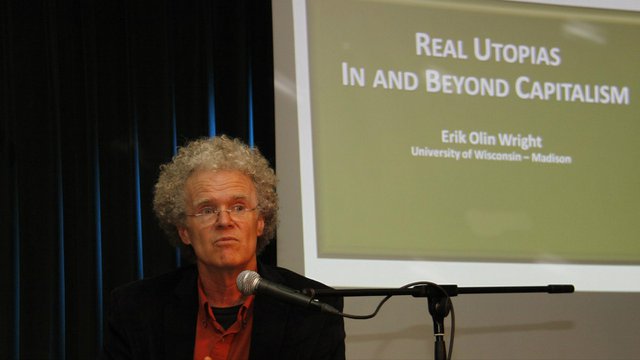
olin-wright.jpg


How to Be an Anti-Capitalist in the 21st Century was meant to be a book in two parts as he describes in the preface.
“I wanted to write something that would be engaging to any reader interested in thinking  about these issues. But I also found it difficult to write about new arguments and themes without the usual academic practices of entering into debates with alternative views, documenting the sources of various ideas that contributed to my analysis, using footnotes to counter various objections that I knew some readers might have, and so on. My problem was basically that I was writing for two different audiences: people who would be interested in the issues but not the traditional academic elaborations, and readers who would feel the book was not intellectually rigorous without those elaborations.” (pp. xi-xii)

The cancer interfered with those plans, but luckily for us he managed to complete part one - for a general audience.In it, Wright lays out an analysis of the failures of capitalism and provides possible approaches to address them. He lays out four theses as summarized succinctly in the afterword written by Michael Burawoy. “First, another world is possible; second, it could improve conditions of human flourishing for most people; third, elements of this world are already being created; and finally, there are ways to move from here to there.” (p. 154) 

I won’t try to summarize the many good points in this remarkably cogent and erudite book. You should read it for yourself. Ask your library to order it. But Wright directs us throughout the work to consider three essential cluster of values in both critiquing capitalism and in forming alternatives – 

Equality/Fairness
Democracy/Freedom
Community/Solidarity

I have a growing realization that it’s at this basic level that our deeper conversations must go to move ahead as a single family on a finite planet. Wright helps us consider those fundamental values and their different meanings to different folks. Spending some time with him and his ideas through the pages of this book is a good tonic, regardless of where one sits on the political spectrum. His tone is a compassionate one, not an angry one. It makes it an easier read. That he dedicated his last days on earth to offer these ideas to us is quite a gift we should treasure and share. Hopefully a couple of readers of this blog will find their way to it and be glad they did.

 9781788736053

Thursday, December 17, 2015

Credit and the Public Good, Part 1

(An earlier version of this was published in City Pulse, a local alternative weekly serving Michigan's Capitol region.)


I suspect that few folks reading this don’t have an account at a bank or credit union. I belong to two credit unions. Credit unions differ from traditional private banks in that they are member owned. This makes it all the more interesting that when I wrote the credit unions I am a member of to ask how we pay our employees, I received no initial response. I asked for three simple figures:
       • What is the minimum beginning wage for a full-time employee?
       • What is the median salary of all employees (the amount that 50 percent of employees make more or     less than)?
       • What is the wage ratio from the bottom to the top?

I looked at their websites before I sent this request, but there is almost no information about how either credit union compensates it employees. I thought OK, I can see where they may not want to share with the larger public, but I was taken back that they wouldn’t share this information with its members/owners.

Now the genesis for this query comes from the physical expansion of both credit unions, which are both statewide entities. Members seem to have no say in the decision-making that goes into this, even though we are member owners? There is little if any transparency in the decision process. The boards has no minutes shared or posted of their deliberations. And in only one case is there even any slim excuse for a financial statement that might allow a member to judge if the expenditures for expansion are warranted.

In the midst of this query into local banking, I tripped upon a new web site http://banklocal.info/ . This site allows you to type in your city and see a rating of local financial institutions and how they rank. They use seven criteria pulled from publicly available data: 
1) Small Business Lending, 
2) HQ Location, 
3) Bank Branch Concentration,
4) Ownership Type,
 5) Bank Size,
 6) Small Farm and Agricultural Lending, and
 7) Speculative Trading. 

They then aggregate scores and rank banks/credit unions according to their impact on the locale. The scoring system is spelled out, so one can decide if the scoring reflects one’s own values.

Lansing has a number of institutions that score STRONG, the highest rating. Neither of my credit unions made that category, each coming is as MODERATE. This was somewhat surprising because credit unions and mutual savings banks get an extra point over shareholder-owned banks. Of course, as I mentioned, one can take issue with the criteria selected in this rating system. But the more important issue for this credit union member is, does the place where I bank align with my values. It wasn’t that long ago when we were looking to refinance our home after interest rates fell that we went shopping for a new mortgage. Universally the loan officers we approached and asked how their funds were invested were surprised that we would ask such a question. I mean, after all, isn’t this activity only about money and the best deal for me? Why should we be concerned about whether the bank invests most of its money out of state as long as my interest rate stays low?

Three of the rating criteria used by Bank Local are around what they do with the money we lend them — do they lend to small business; do they lend to small farms; and do they engage in speculative trading. The website allows you to see how each bank/credit union scores in each criteria. It’s not the most complete transparency that I would like when choosing a financial institution to do business with, but it’s certainly adds some perspective to consider. I still want to know how they share the wealth within the business, thus my three-part question. I’m ready to move my accounts to a financial institution willing to tell me what my money is doing for others. Is there any bank or credit union in this community that is willing to do so? I decided to try one of the STRONG rated credit unions in the area, asking my three questions, indicating that I was shopping for a new home to house my finances. I was promptly and politely informed by the VP of human resources for that credit union, that while they were very proud of their treatment of employees they would not disclose this information to me.

Thinking that this might be a reasonable response to a non-member, I replied asking if I would be able to get this information if I became a member. I’m still waiting for responses. My search for a credit union to bank with continues. You can follow my learning journey here.

Sunday, November 8, 2015

Beyond Individualism

Two books completed recently share some common ground although using different lenses to see it.


George Rupp, former Harvard Divinity School dean, President of both Rice and Columbia University and most recently president of the International Rescue Committee, has penned Beyond Individualism: The Challenge of Inclusive Communities (Columbia University Press, 2015). The chapters are largely recent rewrites of talks he has given over the past decade or so dealing with religion, universities, ecology, global affairs and the search for the 'good life'. The book is in part memoir but more directly a thought provoking inquiry into how to move the human family forward. His global overseas work with International Rescue Committee which deals specifically with refugees from disasters, both natural and human created, clearly pulses through the pages. But he also ties the philosophy and theology of the great religions that he studied in depth over the earlier part of his career. Agnostics and atheists will not be uncomfortable reading his take on the need and possibility for inclusive communities.


Jacobin_series_new_prophets_of_capital_300dpi_cmyk-max_221
Nicole Aschoff, a lecturer at Boston University and editor at Jacobin magazine has put her lens on five icons of the uber successful business world - Bill and Melinda Gates, Oprah Winfrey, John Mackey (Whole Foods), and Sheryl Sandberg (Facebook) in The New Prophets of Capital (Verso, 2015). While she clearly notes their financial success she is more concerned with how they each frame that success and then proselytize it to others. In essence, assuaging any concern about their own massive accumulation of wealth and power.

Read in tandem, they provide a contrast in approaches to tackling the issues of incredible inequality. Aschoff does not linger on the individual wealth of her case studies, but rather on their unflagging belief that capitalism needs only a tweak to repair the damage it has wrought to date.

     They believe that the solutions to our problems lie in refining the existing political and economic system, expanding the reach of capitalist markets,submitting more and more aspects of our lives to a market logic, and channeling our struggles for a better life through corporations. (p.144)

Aschoff holds a dash of hope.

     Instead of thinking about how to fix capitalism, we can start thinking about a different kind of society. We can imagine a world designed for the needs of people instead of profit, and we can get to work building it (p.150).

Rupp delivers an approach that drives us towards increasing inclusivity. His studies and experience have forged a long-term view, one for which he still holds hope.

     Seeking ever greater inclusion may seem like little more than the utopian aspiration of a head-in-the-clouds idealist. I plead guilty to being an idealist in both the philosophical sense (I find Hegel more persuasive than his detractors, to take what for me is a salient example) and also in the more down-to-earth meaning of not easily settling for so-called "realistic" solutions to pressing problems. But seeking greater inclusion cannot only be an aspiration that idealists cherish. It is also an imperative if the international community is going to have any prospect of addressing the crisis of sustained conflict among communities that share a common location. For that reason, the quest for greater inclusion is a worthy ideal and also a practical requirement (p.182).

I only could wish the candidates for President could read him before they take office. And  I wish I could be so hopeful.