Tuesday, January 20, 2015

Changes in Climate - Not What You Think

One of the most senior figures in the UK’s environmental movement of recent decades, Jonathon Porritt, recently made the statement that it is now impossible for the large fossil fuel companies of today to adapt in “a timely and intelligent way to the imperative of radical decarbonization.”

 CleanTechnica logo
So begins a recent article in Clean Technica which calls itself  the #1 clean-tech website in the world. After many years of building relationships with leading corporations in the UK towards sustainable development,
web-porritt-getty.jpg
Porritt, a leading figure globally in transitioning business towards triple bottom line outcomes has thrown in the towel with BP and Shell. Forum for the Future, the organization he founded in 1996 and has led since that time, with side adventures as Chair of the UK Sustainable Development Commission between 2000 and 2009 and he became Chancellor of Keele University in 2012.

In an article in last week's Guardian newspaper, Porritt  discusses his valiant efforts to work with the big oil firms for almost two decades, but concludes with.


"This has been quite a painful journey for me personally. I so badly wanted to believe that the combination of reason, rigorous science and good people would enable elegant transition strategies to emerge in those companies. But we learn as we go. And go those companies surely will, if not in the near future."

The tension has been mounting between the fossil fuel companies and environmentalists as the science continues to show the multiple deleterious effects of the industry. For a clear example, the CleanTechnica article above, which builds on Porritt's Guardian piece, notes the report in Science last week that shows 4 of 9 boundaries for life on the planet have been compromised.

We also learned last week that 2014 was the warmest year on record. Porritt's decision to thrown in the towel with the oil giants is not for having tried. But he found their wanton disregard for the community of life impossible to rationalize.

"And these are companies whose senior managers know, as an irrefutable fact, that their current business model threatens both the stability of the global economy and the longer-term prospects of humankind as a whole. Once knowledge of that kind has been internalised, for any individual, however well-meaning and ‘sincere’ they may be, it must get harder and harder to look oneself in the mirror every morning and feel anything other than moral regret".

Maybe with this knowledge more broadly understood folks will understand the importance of the divestment in fossil fuels. 

February 13 and 14 have been called Global Divestment Day . It's not too late to get involved. 

Sunday, January 18, 2015

Curbing the Athletic Arms Race

The New York Times covered the NCAA convention this past week discussing some of the turbulence around the organization and the big business of college sports. In Friday's article by Ben Strauss, one of the suggestions thrown out by Prof. Andrew Zimbalist, economics professor at Smith College, was "to cap head coaches' salaries at $500,000... and help curb the athletic arms race around the country, while ensuring that the money better serves that academic mission." While I've been calling for similar caps on outrageous salaries for years, it's good to see this leak into a story in the back of the sports section. Something tells me, this won't be reported in the hometown sports sections of towns where the mighty athletic college powerhouses are located.

These salaries, not to mention the other embellishments often added to contracts for the big names in many sectors are outrageous. This is even more so when we look at public sector positions like public universities. In our backyard, today's paper tells the story of the recent firing of the CEO of the locally owned public utility, the Lansing Board of Water and Light.

BWL Logo

The story reveals, what in my experience, is all too common with organizations and their boards - namely that new board members are often brought on because of their public name recognition or connections with other elites; that they frequently have limited knowledge (and sometimes interest) of the organization; and thus they defer to those who have been around the table in the elite club they have joined, rather than question the direction or the decisions of those leading the organization. In the LBWL case, the CEO's contract was given  very little scrutiny by board members when it was drafted and agreed to, as some openly admitted in the article. Now the battle begins about the payout to a fired employee, who managed to negotiate not only a wonderful salary but perks and a nice golden parachute to boot.

 University of Michigan offers Jim Harbaugh $49M six year deal.

One wonders how the University of Michigan Board recently and so swiftly okayed a $40+ million contract with their new football coach, and what kind of buyouts and other perks have been penciled in. Prof. Zimbalist's suggested $500,000 limit is, I believe, quite generous - ten times what the median household income is in the country. This means a football coach, like UM's Jim Harbaugh, who is already a multi-millionaire, would make more in one year, than millions of households would make in ten (and many of those households have two earners)!!!

But for UM and Harbaugh, that's not enough. Instead he will make somewhat more than 120 times what 50 percent of all US households make. The common argument offered in defense of this ludicrous practice is that the market demands it. Or, the another nostrum that conjure up is that they bring in so much money to the institution, as if that is the litmus test for assessing the value of higher education. Higher education has become overrun with neo-liberal economic directives for decades which continue to fuel the arms race that Prof. Zimbalist addresses. Is it any wonder that so many students see a college education as simply a way to maximize their income. Does this mean that philosophy, literature, languages, art or music teachers should be paid by the amount of money they bring to campus? In practice, the answer is yes, as one can see by looking at  most universities' salaries across disciplines. But then shouldn't this defense support the paying of the players????

And of course the ticket prices go up, as do the construction of plush private boxes for the those in the elite clubs that rub shoulders with the board, and don't forget the bumps to the cost of tuition. And educated people think this escalator of madness makes sense?

It doesn't say much for a higher education does it, that the vast majority of those making these decisions are themselves graduates of higher education institutions. The issue is clearly larger than just coaches outrageous salaries. For a more nuanced and insightful analysis see Frank Fear's essay in the LA Progressive  "Game Plan for College Sports Reform", or his other compelling analysis of sports in his blog at The Sports Column.

Sunday, January 11, 2015

Commencement, Honor vs. Greed

$47,500 to speak at a commencement address. And I thought that the invitation to give a commencement address was an honor in itself. But not for Michigan State University (MSU) and George Will. It will be interesting to see if the market for commencement speakers will be driven higher.

There was a similar hubbub in 2011when New Jersey state legislators proposed a ban on commencement speaker fees after Rutgers offered Toni Morrison $30,000 and Musician John Legend received $25,000 for serenading graduates at Keane University's 2011 graduation ceremony. An Inside Higher Education article from the same spring commencement season noted that the figures have gone much higher. Katie Couric, the $15 million a year newscaster, received $110,000 from University of Oklahoma in 2006 and Rudy Giuliani received $75,000 and now regularly requires $100,000 plus a private jet according to the article.The real irony of this greed game, is that the people receiving these funds are generally very well off and don't need the exorbitant payoffs.

I remember the catharsis I suffered from years ago as I invited speakers to campus.,trying to assess with very small budgets how much to pay folks adequately for their service while trying to responsibly manage a budget. As a rookie at this, I often succumbed to the demand of the speaker, assuming it was within my ability to cover the costs. (Additional costs for speakers typically include travel, lodging, and meals). What started to shift my thinking was a response I received from an invited speaker to my question about how much they needed to receive to make the trip. It came as I was developing a weekly speakers series over 12 weeks. And the response was from a senior woman scholar in her field. She said, "Beyond travel costs, I don't care as long as it is equal to any male you are paying." My immediate reaction was, wow, why didn't I think of that egalitarian approach. And of course, I did make sure she received at least as much as any male we invited that semester.

But of course this whole paying for speakers is much more complicated calculus. Like the commencement addresses, all the speaking events I organized were free and open to the public. So there was no cost recovery option one might use like charging an admission fee. How long will they be visiting? Is the speech their only required activity while visiting? Or will they be visiting classes, meeting with others? How long does the travel back and forth take and thus how much of their time is tied up in visiting with us? These factors all play a part. Likewise, many speakers use their speaking funds to raise money for organizations they lead, especially the case with non-profits.

One of the reasons price escalate for popular speakers is that the demand for their time goes up, and one way to  suppress a demand that they can't meet, is to raise prices for their services. Towards the end of my tenure as one responsible for bringing speakers to campus I developed what I thought was a fair bottom line approach.. Beyond travel expenses I decided that an offer of $1,500 a day for each day of speaking was an adequate wage based upon the following logic.If one just did speaking and received $1,500 a day and spoke five times a week  for 50 weeks they would pull in $375,000 year. Not a bad salary. Enough to put them in our lofty one percent elite, not to mention being well-fed. But heck, even if they only gave one speech a week they'd tally $75,000 a year, 50% higher than the median HOUSEHOLD income.

But back to commencement speakers' fees. Being asked to give a commencement address, whether at a high school, college or university is an honor. And often the honor is added to by the receipt of an honorary degree. Other than travel costs, there should be no honorarium, as it taints the whole idea of  honor by its purchase. I'd suggest that those who are invited to give commencement addresses should feel honored whether they receive an honorary degree or not. And those who seek to be compensated for expenses beyond their travel costs should not be given a podium. There won't be any shortage of available thoughtful commencement speakers. Michel Moore who gave one of the other commencement addresses the same weekend at MSU received and sought nothing. His behavior is not an uncommon one. Let's hope that MSU and other public educational institutions end this greedy practice. If private institutions want to pay outlandish fees for a 15 minute speech, it's their money.


Monday, January 5, 2015

Is Bigger Better


Michigan State University(MSU) has been on a growth spurt in recent years topping 50,000 students for the first time this past fall. The growth of the student body isn’t the only sign of expansion at MSU. MSU has  been operating under the planning assumption that they will continue to grow into the foreseeable future (MSU 2020 Vision). Based on a past growth rate that added one million square feet of building space per decade, the Master Plan still assumes that growth rate into the future, and that doesn’t include expansion to off-site campuses in Grand Rapids or the recently announced Flint campus. We do live in a culture where ‘bigger’ is often construed as ‘better’.  But is this the true measure of whether a university is a ‘great’ university nurturing the public good?

 Walter Adams 1.jpg

Former MSU President and economics professor, Walter Adams wrote a highly-regarded book in the mid-80s in which he and his co-author, James Brock challenged the myth that bigger was better and more efficient.

Front Cover

 The Bigness Complex, the publisher's site (Stanford University Press) tells us

     "demonstrates how bigness undermines our economic productivity and progress, endangers our democratic freedoms, and exacerbates our economic problems and challenges."

Their concerns in the mid 80s predate our growing understanding of climate change, which should heighten those concerns about growth. The laws of physics tell us you can’t have infinite growth on a finite planet. 

But MSU's continued growth seems to ignore these concerns raised by Adams, Brock and now climate scientists. Expanding our built infrastructure has significant current and future costs that are being passed on to current and future generations i.e., student debt, climate change. Besides the initial huge capital outlay to add those million square feet, the costs to light, heat, cool, and maintain those spaces is considerable. While under the dominant myth of neoliberal economics we need only worry about the economic costs (especially short term ones) the conveniently ignored environmental and social costs may be many times higher.

A reasonable person might support additional space if it was to be powered with carbon neutral sources, but effectively little of it is. To continue to add additional built space that is powered by carbon based energy in light of all the warnings regarding climate change seems to reflect an air of aloofness, not simply towards the community of life we share this magical planet with, but of the second law of thermodynamics. 


If MSU truly wants to “Be Spartan Green” it might begin with a building moratorium. Continued growth on a finite planet cannot go on forever. Higher education, especially in the developed world, is not exempt from that basic physical law. This is brought to the surface most recently with the report of the new hook-up of the Facility for Rare Isotope Beams (FRIB) with the MSU Power Plant.

 Camera Image
Bob Ellerhorst, director of utilities noted in a WKAR “Current State” interview that he anticipates that when the FRIB is running it will, by itself, use 30 percent as much electricity as the entire campus. Maybe MSU officials are not concerned about paying for those bills in hopes the Feds and/or user fees will cover the costs. But even so they should be held responsible for how that power is generated and the greenhouse gases that are released as a result.


When MSU began its push to be selected as the site for the FRIB a decade ago, this issue was raised. From all I can tell, those concerns fell on deaf ears. If someone else is paying for it, why should it be of concern to us? Because carbon emissions continue to increase and the impacts are shared with the entire human family and long into the future. MSU cannot exempt itself from its responsibility to cut carbon emissions, let alone increase them.


While the FRIB is a one of a kind research facility and will likely be used by physicists throughout the world regularly, some other recent campus additions fail that uniqueness test. Most notably the recent addition to Spartan Stadium.
 Skandalaris-Football-Center
In June 2013, the Michigan State Board of Trustees approved a $24.5 million project to the north end of Spartan Stadium that opened in August 2014. The new structure features a two-story, 50,000-square-foot addition as well as an entrance plaza, renovated gates, and additional restrooms and concessions. The building includes new locker rooms for teams, coaches and officials, including a 4,500-square-foot home locker room and a 700-square-foot home training room, in addition to a 3,600-square-foot media center and a 4,000-square-foot engagement center for all varsity sports.
... Photo Album of the North Endzone of Spartan Stadium Expansion Project

MSU plays seven home games a year. Mostly this structure will remain vacant and underused most of the year. I don’t have any figures on the amount of carbon based energy it will use during the year, but the embodied energy alone that went into its construction with excavation and the huge amounts of concrete could have been more productively utilized.
.

What’s at play here I think, as Adams and Brock more eloquently and thoroughly demonstrated is the mistaken belief that bigger is better. Somehow our administrators convinced the Board of Trustees that if we just have a 4,500 square foot home locker room a player can sit in seven times a year we will be a better university. With a former coach and player on the board, perhaps this isn’t so surprising. But is this what leaders of public universities believe makes them worthy of the public trust and support, especially in a world of rising student debt and accelerating climate change?


That $24.5 million could have provided water filters for almost every family in Burkina Faso with a whole lot less carbon released into the atmosphere. Water, that thanks to the climate change these actions help accelerate, will be, as the climate models seem to predict in ever shorter supply.

The competition for biggest is killing us. Not making us or the community of life we share better. And don't even get me started on the University of Michigan's $40+ million contract for a new football coach -  a campus that boasts the BIGGEST football stadium of any U.S.college or university.

Michigan Stadium 2011.jpg It just might be time for the equivalent of a Ghostbusters approach to address unrelenting growth on our college campuses. Ooops, looks like someone beat me to the punch - checkout GrowthBusters.

Saturday, December 27, 2014

On Lost Causes, Climate Change, and Possibilities


To be honest, I really like Naomi Klein’s work – her crisp analysis of complex issues and her manner of conveying those insights.

Naomi Klein
I’ve read “Shock Doctrine” and other shorter pieces and saw her give an astonishing lecture a few years back based on only a few notes that wove a complex set of issues into a coherent whole.


 That being said I was not sure I was up for reading her 500pp+ new book “This Changes Everything”.

 img-book
I assumed I knew everything she was going to say. But I had put a notify request on the title at the library when it was ordered, so when it came in a couple weeks back I thought I should at least give it a short whirl. I’m on page 370 of 466 pages of prose followed by 60 pages of notes. It’s been a good read. And while I know most of what she has laid out here, there are both new nuggets and a distinctive whole to her well written analysis that I’ve have enjoyed and been inspired by. In short – I highly recommend the read….

Today I read another fervent piece on climate change by another favorite author of mine, Rebecca Solnit. "Let's leave behind the age of fossil fuel. Welcome to Year One of the climate revolution" was published this past week with yet a bit different twist.

Like Klein she is a keen analyst of the human condition, and arguably a more  prolific writer on our condition. Her insights are fresh, as you'll see.  I won’t summarize this, as it is short enough to read as printed in The Guardian

Then this evening I read this very interesting piece by the international relations scholar, Richard Falk, entitled “ On Lost Causes and the Future of Palestine”. 

 Richard Falk (YouTube screenshot)
While unlike the other two pieces it doesn’t deal with climate change. His jumping off point is a reflection on the late Palestinian scholar Edward Said’s concept of “Lost Causes”. This is what links so closely with the pieces by Klein and Solnit.  Read separately, they will have some impact on the reader. Read together, they may transform us. And that's the possibility worth sharing….

Monday, December 15, 2014

Linking Economics and Climate Change

Joseph Stiglitz, former World Bank economist, member of the Council of Economic Advisers was awarded the Nobel Prize in Economics in 2001, just months after the September 11th attack of the twin towers in NYC. The following are his concluding remarks in his acceptance speech (December 8, 2001).

joseph-stiglitz

     I entered economics with the hope that it might enable me to do something about unemployment, poverty and discrimination. As an economic researcher, I have been lucky enough to hit upon some ideas that i think do enhance our understanding of these phenomena. As an educator, I have been lucky enough to have had the opportunity to reduce some of the asymmetries of information, especially concerning what the new information paradigm and other developments in modern economic science have to say about these phenomena, and to have had some first rate students who themselves pushed the research agenda forward.
     As an individual, I have however not been content just to let others translate those ideas into practice. I have had the good fortune to be able to do so myself, as a public servant both in the American government and at the World Bank. We have the good fortune to live in democracies, in which individuals can fight for their perception of what a better world might be like. We as academics have the good fortune to be further protected by our academic freedom. With freedom comes responsibility: the responsibility to use that freedom to do what we can to ensure that the world of the future be one in which there is not only greater economic prosperity, but also more social justice.

Stiglitz has been busy since receiving his Nobel and is currently University Professor of economics at Columbia University. He has been outspoken in his critique of inequality and neoliberal economics including our narrow concept of   development.Increasing inequality and climate change are perhaps two alarm bells that have helped more economists join with Stiglitz and others to note the ills that the neoliberal economic policies have wrought.

Maybe no one makes this more clear than Naomi Klein in her just released This Changes Everything.
 

Klein, who has spent most of her time focusing on the neoliberal economic impacts of globalized trade, has come to see how the worldview associated with climate change denial is fundamentally tied to neoliberal economic worldviews.

     More fundamentally... is their deep fear that if the free market system really has set in motion physical and chemical processes that, if allowed to continue unchecked, threaten large parts of humanity at an existential level, then their entire crusade to morally redeem capitalism has been for naught. With stakes like these, clearly greed is not so very good after all. And that is what is behind the the abrupt rise in climate change denial among hardcore conservatives: they have come to understand that as soon as they admit that climate change is real, they will lose the central ideological battle of our time -- whether we need to plan and manage our societies to reflect our goals and values, or whether the task can be left to the magic of the market. (p.40)

...for more than two decades, we kicked the can down the road. During that time, we also expanded the road from a two-lane carbon-spewing highway to a six lane superhighway. Thar feat was accomplished in large part thanks to the radical and aggressive vision that called for the creation of a single global economy based on the rules of free market fundamentalism, the very rules incubated in the right-wing think tanks now at the forefront of climate change denial. There is a certain irony at work: it is the success of their own revolution that make revolutionary levels of transformation to the market system now our best hope of avoiding climate chaos. (p.56)

Klein allows that
     It's not that the companies moving their production to China wanted to drive up emissions: they were after the cheap labor, but exploited labor and an exploited planet are, it turns out, a package deal. A destabilized climate is the cost of deregulated, global capitalism, its unintended, yet unavoidable consequence.

Political scientists, John Dryzek and Hayley Stevenson, try to see how we might come to some global agreement on how to address climate change in their new book, Democratizing Global Climate Governance (2014).
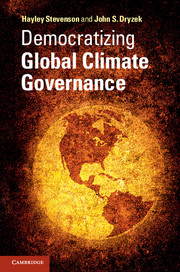
Democratizing Global Climate Governance
They are less concerned about the climate deniers, since they are a tiny minority, especially of those who attend the global climate meetings they have studied. Dryzek and Stevenson instead look at the variance among those trying to wrestle with finding some sort of global agreement at four recent international meetings. Their findings lead them to identify four different frames (they call discourses) of orientation to addressing climate change.

1) Mainstream Sustainability - which assume that natural relationships are both competitive; partnerships; and win-win and in which economy is related to conservation. Business is seen as seeking profit with a conscience, governments believe in ecologically benign economic growth. They believe in the market's ability to manage climate response.

2) Expansive Sustainability - which assumes the possibility of international equity, a sense of responsibility, and that competition could be fair. They believe that civil society is a major player looking for the common good and that states have material motives but are share common but differentiated responsibilities.

3) Limits - assumes humans are dependent on the non-human world, rejects GDP, sees ecological limits, and development that is not growth. States are self-interested with unsustainable policy goals, but they are potentially capable of enlightened self-interest.

4) Green Radicalism - assumes that there is an inter-connectedness between humans and non-human worlds, that humans are capable of cooperation and solidarity. They see states and corporations are irresponsible, that mainstream environmental groups are ineffective.

These four views clash at the global meetings around climate with the bulk situated between expansive sustainability and limits. These findings seem to dovetail with recent published research showing that facts don't matter as much as the orientation one brings to the table. Perhaps the follow-up question is one that examines what leads anyone to question their basic assumptions about how the world works? Meanwhile the evidence mounts that the climate and our economy are linked. Will our elected and other leaders figure this out in time.




Wednesday, December 3, 2014

Looking for a Deal

The Raw Deal or Some May Call the Real Deal

As my fingers hunt for the right keys on this laptop, millions of my fellow citizens, are out hunting for a 'deal', a 'bargain'. Black Friday is the penultimate holiday for consumerism in the U.S. And for a large majority of those bargain hunters, price is the lone distinguishing factor for the item sought. Now it could well be that the consumer's 'deal' is based upon low wages and compensation at the retail outlet or anywhere along the supply chain. Or it might be arrived at by a firm not paying its fair share of taxes or by cheating on regulations. But the bulk of consumers are either not aware or are not concerned with those costs born by others.

Let me confess, I am not totally exempt from this cultural focus. I was taught by my Depression surviving parents to shop for price, to be thrifty, to wait for the sale price. But part of that thrifty orientation was also getting by with what you had, making do, or repairing rather than replacing. At heart I think we are led to believe via marketing and advertising, that even if we may never make it to enjoy the income of the 1%, if we are shrewd enough, we can enjoy many of the same accoutrements they enjoy.

While we're busy hunting bargains, the extreme wealth and associated power that goes with it, continues to concentrate into fewer and fewer hands. And those hands are better able to shape what we know and think about the world. One recent example is the $100,000,000 spent by the Koch brothers to bombard the public with messages during the election about candidates and causes they believe in. You or I can't do that. And, of course, the Koch brothers are perhaps only the most extreme example.

This consolidation of power, whether by meglo-maniacs or nation states, is a poison on a finite planet with a growing human population. It's ironic that the day before Black Friday is perhaps this nation's most celebrated day of sharing, followed immediately by a day of addictive acquisition. Perhaps there is no better symbol of the irony than Walmart where millions are lined up to unwittingly line the pockets of four of the top eleven wealthiest people on the planet,  while their workers can't buy a living wage and where some of their own stores have collection boxes for shoppers to help their employees eat.

 Credit: Our Walmart


I am flabbergasted that the irony escapes, or is denied, by so many. But not by Dr. Peter Dreier, E.P. Clapp Distinguished Professor of Politics, and chair of the Urban & Environmental Policy Department, at Occidental College wrote on Black Friday,


      "Economists note that if Walmart paid its employees at least $25,000 a year, a million and a half workers would be lifted out of poverty. That would mean more money staying in communities to support local businesses, helping to create at least 100,000 new jobs.  Demos, a nonprofit research group, released a report finding that Walmart could easily pay every employee $14.89 without raising prices by simply not buying its own stock to further enrich the Walton family."(more here).

So What Are Some New Ideas or to Borrow from FDR, a New Deal?

Here are my suggestions for a New Deal to replace the Raw Deal that so many in our human family have been offered. The data is conclusive and near unanimous, that income inequality has skyrocketed. This has occurred most notably in the U.S. and the U.K. since the combined efforts of the Thatcher/Reagan policies that reduced taxes on the wealthiest and attempted to starve all the functions of government (save military spending). The wealthy can afford their private education, health care, transportation, etc. so they need not worry about the others. They get to hand down their wealth in greater and greater amounts to their children, who like George W. Bush was born on third base but thinks he hit a triple.

1) The New Deal would put a 10 times wage ratio in place. That's generously more than the 9 times rule in place at the very successful 85,000 employee owned Mondragon Co-operative in Spain. We will initially tie that ratio to a base equal to the median household income, currently approximately $50,000. This means that the highest income would be $500,000. All income above that is taxed at 100%.

 Logoingles.jpg

The new IRS report for the 400 largest incomes (2010) was just released. The average income of the top 400 was reported as $265 million. Under my proposal  they would have to scrimp by on only $500,000 (of course they probably have enough wealth that that figure is meaningless). The tax revenues raised from these 400 tycoons alone under this policy would be $105 BILLION. 

2) Capital gains are taxed at the same rate as real income.

3) Selling of stock held for less than six months is penalized with a progressive tax. The tax increases correlated to the shortness of time the stock is held, e.g., if you hold for less than a day, you pay a penalty equal to the amount exchanged. If you hold for more than six months, no penalty! This reduces speculation, and specifically speculation driven by computer programs that add no real value to the economy.

The increased revenues to government from these three policy changes could provide for free K-16 education for all who are adequately prepared; universal health care; investments in renewable energy; energy, resource, and transportation efficiency; and stewardship of our natural resources. The government becomes the employer of last resort, so that everyone has a job, a livelihood and makes a contribution to the society.

4)  Institute participatory budgeting - give the citizens a direct voice in how those revenues are spent. In 2008 the American Political Science Association formed a task force to look at democracy, economic security and social justice as the economic convulsion was hitting. That task force completed its report in 2011 Democratic Imperatives: Innovations in Rights, Participation, and Economic Citizenship. The report recommends more public governance through mechanisms like public budgeting.


The Participatory Budgeting Project

In participatory budgeting citizens get to suggest programs and projects to spend some portion of tax revenues and then vote for their choices. Programs and projects receiving the most votes get funded. The benefits to the community and the democratic culture are many.

There are clearly more ideas we could test and try out that would move us away from exponential growth on a finite planet, where the benefits accrues mostly to a small minority. It is way past time we come together to discuss the possibilities for building a more sustainable future. To wait any longer to do so invites increasing struggle for many and will leave our children a world more badly broken.